- هانكي
- مدونة
خطر حدوث واقعة واحدة غير مكتشفة لتفريغ الشحنة الكهروستاتيكية (ESD) داخل بيئة تصنيع إلكترونيات حديثة هو أن لوحة دوائر مطبوعة ذات قيمة عالية لن تعمل، وربما بعد عدة أسابيع من اجتياز الفحص النهائي. يعتبر الفشل الكامن الذي لا يمكن اكتشافه من خلال فحوصات الجودة القياسية أحد الأسباب الأكثر شيوعًا لمخاطر الموثوقية لسلسلة التوريد العالمية للإلكترونيات. نظرًا للكثافة الأعلى، والمكونات ذات الملعب الأصغر، وجهود التشغيل الأقل للوحات الدوائر المطبوعة، فقد زادت قابليتها لتفريغ الشحنة الكهروستاتيكية بشكل كبير.
لا يقتصر الأمر على كونه مجرد وسيلة للحماية من الكهرباء الساكنة، بل إن تغليف الحماية من الكهرباء الساكنة هو أيضًا نظام متكامل مصمم للتحكم في التأثيرات الكهروستاتيكية طوال عمر المنتج، بغض النظر عما إذا كنت تقوم بتصنيعه على آلة SMT الخاصة بك، أو تتعامل معه في غرفة نظيفة، أو تشحنه باستخدام الشحن الجوي أو الشحن البحري، أو تخزنه لفترات طويلة في مستودع؛ فقد تم استخدام تغليف الحماية من الكهرباء الساكنة في جميع مراحل دورة حياة المنتج. تقدم هذه المقالة تقييمًا شاملاً لتغليف الحماية من الكهرباء الساكنة من الناحية الفنية والبيانية لمصنعي لوحات الدوائر المطبوعة؛ بما في ذلك أنواع الأعطال التي يمكن أن تحدث، والمبادئ الهندسية لكيفية عمل تغليف الحماية من الكهرباء الساكنة، واختيار المواد، ومعايير تغليف الحماية من الكهرباء الساكنة الدولية، ومخاطر الكهرباء الساكنة في سلسلة التوريد، وأفضل الممارسات لشراء المواد المستخدمة في صنع تغليف الحماية من الكهرباء الساكنة.
فهم عبوات ESD
تُصمم عبوات ESD خصيصًا لإدارة الخصائص الكهروستاتيكية لوحة الدوائر المطبوعة (PCB) أثناء جلوسها / تخزينها / نقلها.
يمكن للبلاستيك القياسي أن يخلق ويحتفظ بشحنة كهربائية ساكنة؛ في حين أن تغليف ESD له ثلاث وظائف كهربائية رئيسية بناءً على تصميمه.
- تبديد – تحرير الشحنات الساكنة بأمان من سطح العبوة بمعدل متحكم فيه.
- التدريع – منع المجالات الكهروسكونية الخارجية من الوصول إلى لوحة الدوائر المطبوعة المغلقة، وتعمل كقفص فاراداي.
- عزل – منع تراكم الشحنات الكهربائية الساكنة المتولدة عن الاحتكاك بين مادة التغليف والمنتجات.
تحقق معايير الأداء الكهربائي هذه (المقاومة السطحية، زمن اضمحلال الشحنة، وفعالية الحماية) الوظائف المطلوبة - وليس فقط من خلال الحماية الميكانيكية حصرياً [أي، باستخدام كيس البولي إيثيلين]. مع كيس بولي إيثيلين ذي تصميم سيئ، لا توجد حماية كبيرة من التفريغ الكهروستاتيكي. يمكن لكيس الحماية من التفريغ الكهروستاتيكي المصمم بشكل صحيح تقليل احتمالية الضرر الكهروستاتيكي بعدة أضعاف مقارنة بكيس مصمم بشكل غير صحيح حقيبة حماية من الكهرباء الساكنة.
رؤى صناعية: يرتبط أكثر من 30% من حالات الإرجاع الميداني غير المبررة في مجال إلكترونيات السيارات بأعطال كامنة مرتبطة بالتفريغ الكهروستاتيكي (EOS/ESD Association، 2022).
لماذا تعتبر حماية التفريغ الكهروستاتيكي (ESD) أمرًا بالغ الأهمية في سلاسل توريد لوحات الدوائر المطبوعة (PCB)
أحد المخاوف الرئيسية المتعلقة بالموثوقية في التصنيع الإلكتروني ينبع من التفريغ الكهروستاتيكي (ESD). النوع الأكثر إيقاعًا للضرر من التفريغ الكهروستاتيكي هو الفشل الكامن، الذي يختبئ في الداخل ولا يسبب فشلًا قصير الأمد يؤثر على الوظيفة الفورية، ولكنه بدلاً من ذلك يؤدي إلى فشل مبكر بسبب الدورات الحرارية، أو الضغوط الميكانيكية، أو التحميل الكهربائي الممتد.
تُسمى الأعطال الميدانية التي تظهر بعد أشهر دون أن يكون سببها واضحًا للمستخدم «الأعطال الميدانية الكامنة». وتشير جمعية EOS/ESD إلى أن الأعطال الكامنة المرتبطة بالتفريغ الكهروستاتيكي (ESD) تمثل 30% من إجمالي حالات الإرجاع من الميدان لأسباب غير مبررة؛ ويحدث هذا بشكل أكثر تكرارًا في الأسواق التي تتطلب درجة عالية من الموثوقية.
- إلكترونيات السيارات – حيث يمكن لوحدة تحكم إلكترونية واحدة معيبة أن تؤدي إلى عمليات استدعاء على نطاق واسع.
- أنظمة الطيران والفضاء – حيث الفشل ليس خيارًا وتكاليف الخدمة الميدانية فلكية.
- أنظمة التحكم الصناعي – حيث يعطل التوقف غير المتوقع خطوط الإنتاج بأكملها.
- تغليف أشباه الموصلات – حيث تحتوي الدوائر المتكاملة المتقدمة على طبقات أكسيد بوابات بسماكة نانومترات قليلة فقط.
إليك ما يجب أن تعرفه: الأجهزة التي تعمل بشكل صحيح عند اجتيازها للاختبارات الأولى وتم تجميعها بشكل صحيح لا تزال عرضة للتلف الناتج عن التفريغ الكهروستاتيكي حتى تتعرض لضغط الاستخدام الفعلي. لهذا السبب، فإن توفير الحماية من التفريغ الكهروستاتيكي يدور حول بناء الأجهزة بشكل موثوق، وليس حول لوجستيات تغليفها.
نصيحة للمشتري: عند تقييم موردي لوحات الدوائر المطبوعة، اطلب الامتثال لبرنامج التحكم في التفريغ الكهروستاتيكي الخاص بهم وفقًا لـ ANSI/ESD S20.20 — هذا هو المعيار الصناعي الأكثر قبولًا.
آليات الفشل الكهروستاتيكي في أنظمة لوحات الدوائر المطبوعة
تعاني بيئات لوحات الدوائر المطبوعة (PCB) من أضرار التفريغ الكهروستاتيكي (ESD) نظرًا لعدد من الآليات الراسخة، والتي يجب على المهندسين فهم كل منها لاتخاذ قرارات مستنيرة بشأن التغليف والمناولة المناسبين.
1. تلف ESD الكامن
عندما يتسبب حدث التفريغ الكهروستاتيكي (ESD) في حدوث عيوب مجهرية في وصلات أشباه الموصلات أو عوازل البوابة، سيحدث تدهور داخلي للعازل. في حين أن هذه العيوب لن تدمر الجهاز فورًا، إلا أنها ستضعفه. بمرور الوقت، قد يتعرض الجهاز للفشل بسبب الدورات الحرارية، أو الاهتزازات الميكانيكية، أو الإجهاد الكهربائي المطبق على المنطقة الضعيفة. في معظم الأحيان، لا يكون الضرر الكامن مرئيًا من خلال الاختبارات الكهربائية العادية؛ لذلك، فإن الضرر الكامن هو سبب العديد من حالات فشل ESD في الميدان.
2. الشحن القبلي
عند ملامسة عنصرين لبعضهما البعض وفصلهما، تنتقل الإلكترونات من إحدى الأسطح إلى السطح الآخر مما يؤدي إلى توليد شحنة كهربائية تظل عند فصل العناصر. تحدث هذه العملية بشكل متكرر عند التعامل مع لوحات الدوائر المطبوعة (PCBs) ويمكن أن تحدث عند انزلاق المكونات عبر صواني البوليمر، وتقشير طبقة الحماية الساكنة من لوحة الدوائر المطبوعة العارية، أو أثناء دوران البكرات على آلة التقاط ووضع تقنية التركيب السطحي (SMT). غالبية أحداث التفريغ الكهروستاتيكي (ESD) في الإنتاج الآلي ترجع إلى الشحن الاحتكاكي (التفريغ الكهربائي الاحتكاكي).
3. تأثيرات الرطوبة البيئية
يؤثر مستوى الرطوبة على السرعة التي يمكنك بها إزالة الشحنات الكهربائية الساكنة من الأسطح بسرعة كبيرة؛ لذا، إذا انخفضت الرطوبة النسبية إلى ما دون 30%، فإن السرعة التي يمكنك بها إزالة أي شحنة تتأثر بشكل كبير، وقد تصل الشحنات الكهربائية الساكنة إلى عدة آلاف من الفولتات. ويمكن أن تشكل مستويات الشحنات الكهربائية هذه في الهواء خطورة خاصة في مجال الشحن الجوي؛ حيث يمكن أن تقل الرطوبة في مقصورة الطائرة عند الارتفاعات العالية عن 10%، وكذلك في المستودعات الواقعة في المناطق ذات المناخ البارد خلال فصل الشتاء.
الجدول 1: مقارنة آليات فشل التفريغ الكهروستاتيكي
| نوع الفشل | آلية | رؤية | توقيت | مستوى المخاطر |
|---|---|---|---|---|
| فشل كامن | التحلل العازل | غير مرئي | تأخير | عالي جدا |
| فشل كارثي | انهيار التفريغ المباشر | مرئي | فوري | حاسم |
| الشحن بالاحتكاك | تراكم الشحنات الاحتكاكية | غير مرئي | مرحلة التعامل | عالٍ |
| الشحن المدفوع بالرطوبة | تفريغ شحن مخفض | غير مرئي | بيئي | عالٍ |
رؤى صناعية: تشكل الإخفاقات الكارثية - تلك التي تتسبب في أضرار مرئية فورية - من 10 إلى 20 بالمائة فقط من جميع أحداث التفريغ الكهروستاتيكي. الغالبية العظمى تكون كامنة، وتتسرب عبر فحوصات ضمان الجودة القياسية.
مبادئ الهندسة لتغليف ESD
المكونات الأساسية لـ تغليف ESD تستند إلى بنية تحكم كهروستاتيكية متعددة الطبقات. على الرغم من أن التصميمات ستختلف اعتمادًا على الاستخدام المقصود، إلا أن الهيكل الأساسي سيتكون من ثلاث طبقات وظيفية أساسية.
- طبقة تبديد – بشكل عام، سطح داخلي بمادة موصلة محددة (10^6ceDitto 10^*0Dorrnit &0.^0Z) تسمح بتفريغ آمن أو تدريجي.
- طبقة موصلة يتم توزيع الشحنة الكهربائية على مساحة كبيرة عبر موصل مدفون داخل عازل عازل: والنتيجة هي فرق جهد قريب من الصفر بين النقاط على الموصل.
- طبقة التدريع بشكل عام، طبقة معدنية (ألومنيوم مترسب على بوليستر) تعمل كقفص فاراداي وتمنع المجالات الكهروستاتيكية الخارجية من التأثير على لوحة الدوائر المطبوعة المغلقة.
بفضل هيكلها المكون من ثلاث طبقات، يوفر هذا التصميم تحكمًا داخليًا في الشحن (ولكنه يمنع أي تراكم للجسيمات المشحونة نتيجة للتأثير الاحتكاكي) ودرعًا ضد المجالات الكهربائية الخارجية (مما يمنع تلف المكونات بسبب مصادر كهربائية قريبة). يعد التصميم ثلاثي الطبقات ضروريًا للغاية لأي جهاز يحتوي على مكونات حساسة للغاية، على سبيل المثال، الدوائر المتكاملة المتطورة، أو وحدات التردد الراديوي، أو مستشعرات MEMS.
معايير الأداء الرئيسية
يعتمد اختيار تغليف ESD على تأهيل تغليف ESD باستخدام خصائص كهربائية قابلة للقياس. يلخص الجدول أدناه المواصفات الأكثر أهمية والتي تحددها المعايير الصناعية.
| معامل | النطاق النموذجي | دالة | دور هندسي |
|---|---|---|---|
| مقاومة السطح | ١٠⁶–١٠¹¹ أوم/مربع | تبديد الشحنة | يمنع تراكم الشحنات الساكنة على أسطح التعبئة والتغليف |
| زمن انحلال الشحنة | أقل من ثانيتين | سرعة التفريغ | يضمن تحييداً سريعاً للشحنات المتراكمة |
| فعالية الحجب | 40 ديسيبل | حجب المجال | يقلل طاقة التفريغ الكهروستاتيكي الخارجية إلى مستويات آمنة للدوائر المتكاملة |
| استقرار الرطوبة | 20%–80% RH | القدرة على التكيف البيئي | يحافظ على الأداء في ظل ظروف اللوجستيات الواقعية |
| المقاومة الحرارية | حتى 160-200 درجة مئوية | تحمل الحرارة العالية | Enables compatibility with SMT reflow and baking processes |
The charge decay time test evaluates the time required for an initial voltage (usually +/- 1000 volts) to decay to a value of 10% of the original voltage to measure the ability of material to dissipate a charge. According to IEC 61340-5-1, a requirement will be met if the measured charge decay time is greater than or equal to two seconds. If the range of surface resistivity on a material is in the dissipative region, but the measured charge decay time is greater than two seconds, the material may not be appropriate for use.
Materials Used in ESD Packaging Systems
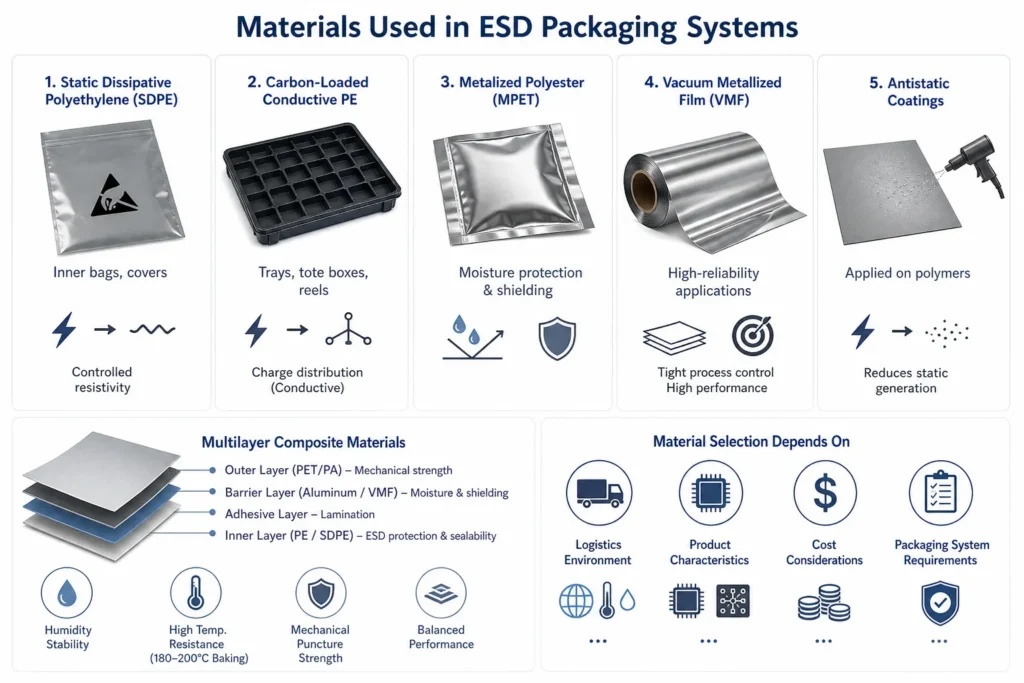
ESD packaging materials consist of engineered composites, which are carefully selected based on their unique properties (e.g. electrical, mechanical and thermal) to meet specific needs. Examples of commonly used materials in ESD packaging include:
- Static dissipative polyethylene (SDPE) – a flexible film with controlled resistivity, used for inner bags and covers.
- Carbon-loaded conductive polyethylene – used for trays, tote boxes, and component reels where charge distribution is needed.
- Metalized polyester (MPET) – A thin aluminum layer is deposited on a PET film so that it can provide moisture protection and shielding. I often use polyethylene, which means it is usually used in multilayer foil packaging bags.
- Vacuum metallized film (VMF) – similar to MPET but with tighter process control, often used for high-reliability applications.
- Antistatic coatings – topical coatings applied directly to polymers to decrease generation of static electricity (though generally not as durable as built-in dissipative products).
Multilayer composite materials are developed by combining materials into advanced package systems that provide balanced performance characteristics of humidity stability, high temperature resistance (baking up to temperatures of approximately 180 – 200 degrees celcius) and mechanical puncture strength. Material selection will vary according to the attributes of the packaging system in relation to the particular logistics environment, the characteristics of the product being packaged, and costs considerations.
Manufacturing and International Standards
ESD packaging manufacture is a controlled polymer engineering process. Key steps include:
- Polymer compounding – Mixing Carbon black, carbon nanotubes, graphene or conductive fillers with the base resin or adding antistatic additives to base resin.
- Extrusion under controlled humidity – ensuring consistent dispersion and surface properties.
- Metallization or coating – depositing thin metal layers via vacuum evaporation or sputtering.
- Multilayer lamination – combining functional layers with adhesives to maintain integrity under flexing and heat.
- Heat sealing and forming – converting film into bags, pouches, or rigid trays.
All ESD packaging should comply with established international standards:
| قياسي | Scope |
|---|---|
| IEC 61340-5-1 | Electrostatic control systems for electronics; the global reference |
| ANSI/ESD S20.20 | ESD control program requirements; widely adopted in North America |
| IPC-1601 | PCB handling and storage guidelines; covers ESD packaging as part of process control |
| RoHS | Restriction of hazardous substances; environmental compliance |
رؤى صناعية: Over 80% of tier-1 electronics manufacturing service (EMS) providers require their packaging suppliers to hold certification for both IEC 61340-5-1 and ANSI/ESD S20.20 to ensure global compliance.
ESD Packaging in PCB Supply Chains
Electronic discharge (ESD) risks extend beyond just factories. Electrical discharges (ESD) pose a risk across the entirety of the worldwide logistics chain. The amount of risk associated with electrical discharges (ESD) is dependent on one’s location.
| البيئة | مستوى المخاطر | Main Source | Recommended Packaging |
|---|---|---|---|
| SMT Production Line | عالٍ | Machine friction, operator handling | Multilayer shielding bags or bins |
| Air Freight | عالي جدا | Low humidity (can fall below 10% RH at altitude) | Metallized shielding film with moisture barrier |
| Warehouse Storage | Medium | Charge accumulation on surfaces | Dissipative bags or covers |
| Cleanroom | عالٍ | Human contact, synthetic garments | Full ESD-protective packaging (bags, boxes, labels) |
| Ocean Shipping | Medium | Temperature and humidity cycles | Moisture-stable composite materials |
Air freight purchasers should request metallized shielding film with shielding effectiveness higher than 40 dB and also have a built-in moisture barrier. Because there is a very low level of humidity and there is a rapid pressure drop while climbing in altitude, there is an additional potential for generating ESD in the air freight environment.
Procurement Guide for ESD Packaging
Choosing a suitable ESD packaging supplier cannot be accomplished solely based on price; engineering performance is another factor to consider. When conducting the technical audit, the following criteria can be included:
- IEC / ANSI compliance certification – verified by an independent third-party (SGS, TÜV, etc.).
- Shielding effectiveness data – measured per IEC 61340-5-1 or ANSI/ESD STM11.31.
- Charge decay test reports – showing < 2 seconds decay time under stated temperature and humidity conditions.
- Humidity and temperature stability – performance curves across the expected logistics range (e.g., 20%–80% RH).
- OEM/ODM capability – ability to custom-design packaging geometry, material selection, and printing.
- Batch-to-batch consistency – internal quality control data showing CPK values above 1.33 for key parameters.
رؤى صناعية: Cost-driven selection of ESD packaging—without engineering validation—has been directly linked to a 5–8% increase in field failure rates among semiconductor packagers. Leading companies now require incoming quality control (IQC) testing on every lot.
أسئلة متكررة
Q1: What is ESD packaging for PCB used for?
Q2: Do PCBs really need ESD packaging?
Q3: Why do PCBs still fail after ESD packaging?
Q4: What is the best packaging for PCB shipping?
Q5: What should buyers check before choosing suppliers?
Q6: Can standard pink‑poly antistatic bags provide adequate protection?
Q7: How often should ESD packaging be requalified?
Q8: Is there a difference between “static dissipative” and “conductive” packaging?
ESD packaging for PCB manufacturers is a technical discipline grounded in electrical engineering, materials science, and standards compliance. It is not an accessory—it is a critical component of the overall reliability assurance system for electronic products. From understanding failure mechanisms and multilayer design principles to selecting materials and qualifying suppliers against IEC and ANSI standards, every decision matters.
For procurement and engineering teams, the takeaway is clear: treat ESD packaging as an engineered reliability solution, not a commodity. Invest in supplier verification, performance testing, and logistics-specific design. The cost of doing so is small compared to the field failure exposure that latent ESD damage can cause—especially in automotive, aerospace, and industrial applications where reliability is paramount.
By applying the principles and data outlined in this guide, buyers and engineers can significantly reduce ESD-related risks and build a more resilient electronics supply chain.
المراجع
- IEC 61340-5-1: Electrostatic Control Standard – International Electrotechnical Commission. https://webstore.iec.ch/en/publication/74748
- ANSI/ESD S20.20: ESD Control Program Standard – EOS/ESD Association. https://www.esda.org
- IPC-1601: PCB Handling and Storage Guidelines – IPC. https://www.ipc.org
- EOS/ESD Association Technical Publications. https://www.esda.org
- MarketsandMarkets. “Electronics Packaging Market Report” (2023). https://www.marketsandmarkets.com
أحدث مشاركة
-
 ESD Slippers vs ESD Safety Shoes for Electronics Factories16 أكتوبر,2026
 -
 ESD Shoe Sole Resistance: Test Methods and Acceptance Limits15 أكتوبر,2026
 -
 How to Verify Cleanroom Sticky Mat Contamination Removal15 أكتوبر,2026
اترك ردًا