- hanqi
- Blog
In various industries including electronics, semiconductors, cleanroom packaging, film converting, medical devices, automotive electronics and precision assembly, uncontrolled static charges can have a detrimental impact on product quality, process stability and integrity over time.As production processes are becoming increasingly automated, the components in those processes are also becoming increasingly sensitive; therefore, static control no longer relies purely on the operator’s experience or visual inspection to control for static electricity. Measurable data is required by the manufacturers in order to gain insight into where the static charge is being generated during the production process, how it travels through its operations, and whether their static control equipment is functioning correctly.The electrostatic field meter is a vital component of the overall process. It is used to identify electrostatic fields, surface voltage, charge polarity and static charge accumulation without contact. As a result, for industry buyers, the electrostatic field meter is much more than a hand-held testing devise it is an integral part of an overall ESD measurement solution that supports quality control, ESD audits, process validation and preventive maintenance.Traditional ESD products such as matting, wrist straps, grounding systems, ionizers, conductive packaging (and other static control products) continue to be an important part of the static control process; however, these products primarily serve the purpose of preventing or reducing static electricity. An electrostatic field measuring device will verify that these products are functioning and producing adequate results under “real-world” manufacturing conditions.Hence, the rationale behind an increase in the number of businesses utilizing electrostatic field meters by B2B procurement teams, quality engineers, and brand owners is to test products and provide static controls for ESD management in an industrial setting.
What Is an Electrostatic Field Meter?
A non-contact instrument called an Electrostatic Field Meter measures electrostatic fields, surface voltage, and charge polarity on materials and/or objects in industrial settings.
Surface Voltage is the electrical potential measured on or near a material surface, often used to evaluate static charge accumulation in ESD-sensitive production areas.
This testing method for different types of insulators, such as plastic products, films, packaging, surfaces, trays, containers and machinery, is done using a charging plate or vacuum inside the instrument; it is very useful for measuring electrostatic charges on these types of surfaces using a remote method, i.e., not physically contacting the test surface. The advantage of using a meter to measure electrostatic fields is that you are able to measure surfaces that have a charge without disrupting either the material being measured or the process itself.
Within an overall programme for controlling static electricity, the electrostatic field meter acts as both a diagnostic and verifying piece of equipment. It provides an engineer with answers to the questions which he or she may have regarding electrostatic fields.
Understanding an electrostatic field meter is essential, more detail you can read our blog”What Is an Electrostatic Field Meter“.
How Electrostatic Field Meters Support ESD Measurement Solutions
A full ESD control solution generally consists of various layers for preventing, monitoring, and verifying the effectiveness of electrostatic discharge (ESD) control measures. The use of static dissipative equipment, grounding equipment, ionizing equipment, conductive materials, and ESD-safe packaging provides a means of eliminating or reducing the generation of static electricity and/or protecting the sensitive product from electrostatic discharge. Nonetheless, effective measurement is essential to determining whether your ESD control measures are actually working.
This is where electrostatic field meters provide value.
Manufacturers can use these solutions to identify and measure static electricity and assess control devices as well as track the risk of static as it relates to their production environment. These can be used for everyday inspections, audits done by customers, troubleshooting of processes, validating equipment, and improving production lines.
| ESD Control Area | Common Equipment or Product | Role of an Electrostatic Field Meter |
|---|---|---|
| Static prevention | Anti static products, grounding systems, ESD mats | Verifies whether static charge remains on work surfaces or materials |
| Static elimination | Ionizers, ionizing bars, ionizing blowers | Measures static levels before and after ionization |
| Risk detection | Static control devices and inspection tools | Locates abnormal charge accumulation points |
| Process control | Inline static monitoring equipment | Provides data for continuous static management |
| Quality management | ESD audit tools and documentation systems | Supports inspection records and customer audits |
In many cases, industries create electrostatic charges unexpectedly. For instance, a plastic cover, conveyor belts, trays, roll film, or packaging materials could create electrostatic charges by means of friction, separation and/or movement. Due to the lack of an electrostatic field meter to quantify the static charge, these risks go undetected until they result in quality issues.
Integrating electrostatic field measurement into daily quality processes allows manufacturers to identify ESD risks sooner and confirm corrective actions and repeatability of processes.

Key Applications of Electrostatic Field Meters by Industry
Depending on the industry, there is variability in how electrostatic field meters are used. For example, some factories use them primarily for ESD auditing, while others utilize them for troubleshooting production problems, verifying ionizers, testing materials, or monitoring processes.
The table below summarizes common industrial applications.
| Industry | Static Risk | Measurement Point | Recommended Use |
|---|---|---|---|
| Electronics manufacturing | PCB, IC, and electronic components may be damaged by ESD | Workstations, trays, packaging areas, test benches, repair stations | Handheld inspection, ESD audit, static source detection |
| Semiconductor production | Wafers, chips, carriers, and microelectronic devices are sensitive to static charge | Wafer handling areas, cleanrooms, loading zones, packaging lines | High-accuracy measurement, process validation, cleanroom monitoring |
| Cleanroom applications | Static charge can attract particles and affect contamination control | Cleanroom garments, plastic containers, work surfaces, transfer carts | Static level monitoring and contamination risk reduction |
| Film and packaging | Plastic film and packaging materials generate charge during winding, printing, and separation | Unwinding, rewinding, printing, labeling, sealing, and cutting sections | Static troubleshooting and ionizer performance verification |
| Medical device manufacturing | Plastic components and sterile packaging may attract particles due to static charge | Assembly areas, packaging lines, inspection stations | Quality control and packaging process validation |
| Automotive electronics | Sensors, control boards, and electronic modules may face ESD risk during assembly | Assembly lines, testing areas, storage zones | ESD risk verification and supplier quality control |
| Aerospace and precision assembly | High-reliability components require controlled static environments | Precision workstations, inspection rooms, component handling areas | Process confirmation and quality documentation |
Market demand for ESD-related equipment is also supported by the growth of electronics packaging, semiconductor manufacturing, and high-reliability industrial production. Fortune Business Insights reported that the global electrostatic discharge packaging market was valued at USD 2.68 billion in 2025 and is projected to reach USD 4.41 billion by 2034, with a CAGR of 5.68%. Although ESD packaging is only one segment of the broader static control ecosystem, its growth reflects the increasing importance of electrostatic protection across industrial supply chains.
Electronics Manufacturing
Electrostatic field meters are a frequent sight during inspection of debris-free workplaces, components on work benches and within repair work areas. Quality teams can use these devices to identify charged items that present an ESD risk to sensitive components.
A portable meter can assist in the daily ESD floor inspection and workstation confirmation procedures as well as to help troubleshoot any unexplained failures that may happen while performing those activities. When participating in the purchasing process, teams will consider factors such as size, measurement distance, resolution, and calibrating the device when choosing a meter.
In semiconductor manufacturing, electrostatic compatibility is particularly important because static charge and electric fields can affect productivity, equipment reliability, and process stability. SEMI E78 provides guidance for assessing and controlling electrostatic discharge and electrostatic attraction in semiconductor manufacturing equipment, making static field measurement relevant not only to product protection but also to equipment-level process control.
Electrostatic Compatibility means that equipment, materials, and processes are designed or controlled to reduce harmful effects caused by static charge and electric fields.
Semiconductor and Microelectronics Production
Semiconductor environments require a greater level of accuracy and environmental control. Electrostatic charge can affect the handling, packaging, inspection and transport of wafers. Therefore, many users will seek equipment that is more accurate, has a stable repeatability, and is compatible with cleanroom environments and comes with a reliable calibration certificate.
An electrostatic field meter is not only a testing instrument when used in a high-value production process but also a component of process risk management.
In electronics manufacturing, ESD control programs often reference sensitivity models such as HBM and CDM. ANSI/ESD S20.20 and IEC 61340-5-1 are widely used for ESD control program requirements, and industry references commonly discuss control thresholds around 100 V HBM and 200 V CDM for sensitive electronic items.
HBM / CDM HBM simulates electrostatic discharge from a charged human body, while CDM simulates discharge from a charged electronic device itself.
Cleanroom and Pharmaceutical Packaging
Particles can be attracted to surfaces, garments, containers and packaging material due to static charge, increasing the likelihood of contamination or altering product handling in clean rooms. The use of electrostatic field metres allows cleanrooms to assess static charge levels, and confirms whether static control products are effective in reducing the risk of contamination.
The use of measurement data can provide support for both internal quality documentation of pharmaceutical packaging and/or medical device manufacturing and also during customer inspection of the product.
Film, Printing, and Packaging
Film conversion, print processing, coating, labelling and packaging processes can generate static charges from various processes such as friction and separation. These static charges cause dust to cling to the film, as well as causing the film to stick to itself, creating misfeeds, print defects & unstable movement of the film.
Operators can use an electrostatic field meter to detect accumulation of charge, as well as whether ionisers and static elimination bars have been installed in the correct position.
Automotive, Aerospace, and Precision Assembly
Parts used in automotive & aerospace electric systems, including electronic assemblies, precision mechanical assemblies, & sensors, have many instances where “high-reliability parts” are needed. Static field measurement can be used for quality management of suppliers, checking of incoming materials, auditing of workstations, & validation of processes.
Typically, in such applications it will be the buyers’ priorities to have durable instruments, obtain consistent readings, and ensure they have long-lasting service support.
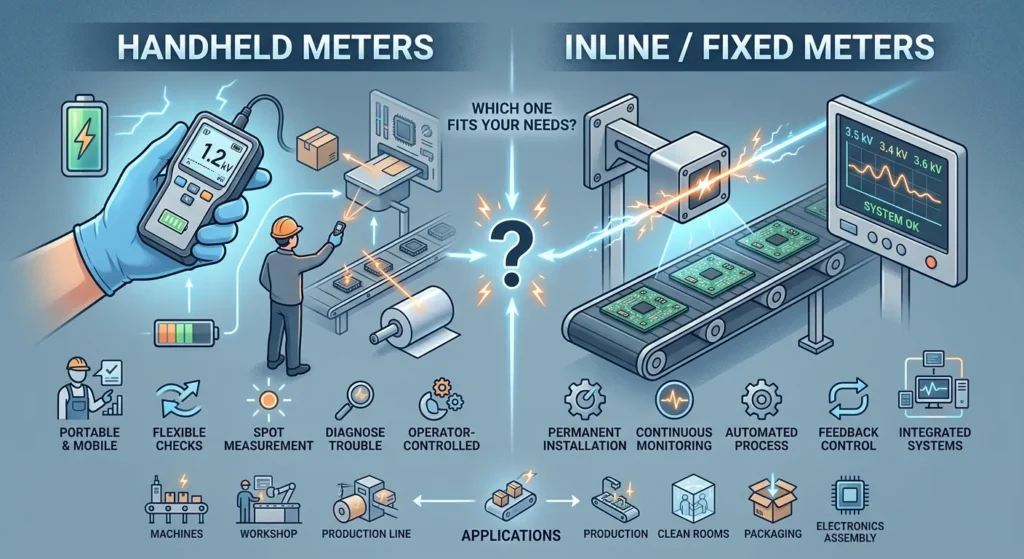
Handheld vs Inline Electrostatic Field Meter: Which One Fits Your Process?
Industrial purchasers will frequently have the choice between the use of a hand-held device or an inline electrostatic field meter. The appropriate decision depends on the application; the frequency at which measurements will be taken; the product layout and; the need for data.
| Type | Best For | Advantages | Limitations |
|---|---|---|---|
| Handheld electrostatic field meter | ESD audits, spot checks, troubleshooting, maintenance inspection | Portable, flexible, easy to use, suitable for multiple measurement points | Depends on operator technique; not suitable for continuous monitoring |
| Inline electrostatic field meter | Automated production lines, continuous process monitoring, fixed measurement points | Real-time measurement, stable installation, suitable for alarms and process control | Requires installation planning and system integration |
| Data-output electrostatic meter | Quality records, process analysis, factory data systems | Supports data logging, trend analysis, and reporting | May require software, communication interface, or integration support |
An electrostatic field meter that can be held in your hands serves a great purpose in factories requiring a flexible inspection process. Engineers can use this type of meter to cover numerous workstations, packing stations, storage areas, and production facilities. An electrostatic field meter is also very useful for performing Static Electricity Discharge (ESD) audits and for maintenance crew members.
Inline electrostatic field meters allow for continuous monitoring of static charge in an industrial production line. They should be installed at high-risk process locations like film unwinding, conveyor transferring, packaging lines, or automatically handling materials.
In the case of brand owners or system integrators, the output of data from a device will become more significant. Use of USB, RS485, analog output, alarm output or software logging functions will allow the customer to connect the static measurement data to a larger Quality Management System.
Technical Specifications Buyers Should Compare Before Purchasing
When selecting an electrostatic field measuring device, B2B purchasers should consider more than just product name. Other factors must be evaluated too such as practical technical specifications. Each application may have different requirements based upon its own measurement environments, accuracy needed, and user skill level. In addition, quality documentation requirements are very important when determining which model will work best in your application.
| Specification | Why It Matters for Buyers |
|---|---|
| Measurement range | Determines the maximum static voltage or field strength the meter can detect |
| Resolution | Shows how small a static change the instrument can display |
| Accuracy | Affects confidence in measurement data |
| Repeatability | Determines whether readings remain stable during repeated checks |
| Measuring distance | Directly affects reading accuracy and consistency |
| Response time | Important for fast-moving materials or production line inspection |
| Polarity indication | Helps identify whether the charge is positive or negative |
| Grounding method | Improves measurement stability and reduces operator influence |
| Data output | Supports logging, alarms, reporting, and system integration |
| Calibration support | Helps maintain long-term measurement reliability and audit credibility |
| Display readability | Important for factory inspection and daily operation |
| Battery life or power supply | Affects field use and maintenance planning |
| Mechanical design | Influences durability, mounting, and ease of use |
A standard handheld meter is generally adequate for measuring electromagnetic field (EMF) exposure in an industrial environment. For EMF exposure measuring in the semiconductor industry, cleanroom environment or high-reliability manufacturing, the user may require more precise measurement capability, as well as greater repeatability and traceable calibration support.
It’s important for purchasers to inquire if the supplier is able to deliver any technical documents, calibration data, user training or application consulting for the products sold. This is particularly relevant information for distributors, brand owners and OEM purchases.
FMX-003 vs FMX-004 Electrostatic Field Meter Comparison
| Item | FMX-003 | FMX-004 |
|---|---|---|
| Positioning | Basic model | Updated model |
| Function | Non-contact electrostatic field measurement | Non-contact electrostatic field measurement |
| Stability | Standard | Improved |
| Display | Basic LCD | Improved readability |
| Operation | Simple manual use | More user-friendly interface |
| Applications | Basic ESD checks, troubleshooting | Production line inspection, ESD control programs |
| Users | Maintenance / basic technicians | Quality engineers / ESD managers |
| Recommendation | Cost-sensitive basic use | Standardized industrial use |
More detail you can read our blog:
Electrostatic Field Meter FMX 003 Vs FMX 004 – SWESD
Electrostatic Field Meter Simco FMX-003 – SWESD
Common Measurement Errors and How to Avoid Them
Incorrect use of even the best electrostatic field meters can lead to false readings. By becoming familiar with some common sources of error in measurement, users can achieve more reliable and useful data.
| Error Source | Possible Impact | How to Avoid It |
|---|---|---|
| Incorrect measuring distance | Readings may be higher or lower than expected | Follow the recommended measuring distance provided by the manufacturer |
| Poor grounding | Readings may drift or fluctuate | Use proper grounding methods and avoid floating measurement conditions |
| Nearby charged objects | The meter may detect surrounding fields instead of the target object | Keep the measurement area clear and isolate the target as much as possible |
| Operator movement | Human body charge may influence readings | Use proper ESD protection and keep hand position stable |
| Humidity variation | Static generation and dissipation may change | Record environmental conditions during measurement |
| Airflow or ionized air | Static decay behavior may be affected | Measure under stable conditions when comparing results |
| Low battery or unstable power | Display may become unstable | Check battery condition and maintain the instrument regularly |
| Sensor contamination | Measurement accuracy may decline | Keep the sensing area clean and follow maintenance guidance |
| Wrong measurement angle | Readings may not reflect the target surface accurately | Keep the meter aligned according to the user manual |
| Lack of calibration | Long-term drift may reduce data credibility | Calibrate the meter according to quality system requirements |
Errors in measurement are very significant with regard to ESD audits, customer audits, and process validation. A correctly developed measurement procedure is equally as important as the equipment used.
It is a good idea for industrial teams to create a Standard Operating Procedure (SOP) that details the following information when preparing a measurement: distance from the receiving point, grounding method, target position, environmental recording(s), and all calibration requirements. This will help to ensure that there is less variation in measurements taken at various sites by multiple operators.
More detail you can read our blog:
How To Use Electrostatic Field Meter? – SWESD
Understanding Electrostatic Field Meter Data – SWESD
Electrostatic Field Meter Calibration – SWESD
Calibration, Maintenance, and Long-Term Reliability
Calibration is a key factor in the long-term reliability of electrostatic field meters. For buyers who use the instrument in quality audits, customer inspections, cleanroom verification, or high-reliability manufacturing, calibration documentation may be as important as the product specification itself.
Before purchasing, buyers should check whether the supplier can provide:
- Calibration certificate or calibration report.
- Recommended recalibration interval.
- Zero adjustment or zeroing procedure.
- Maintenance instructions.
- Sensor cleaning guidance.
- Battery or power supply maintenance information.
- Repair or replacement support.
- Technical documentation for quality systems.
The recalibration interval may depend on the user’s internal quality system, measurement frequency, application risk, and industry requirements. Instruments used in critical production areas usually require more careful maintenance and documentation than instruments used for occasional troubleshooting.
Long-term reliability also depends on design quality. A reliable industrial electrostatic field meter should offer stable readings, durable housing, clear display, repeatable performance, and resistance to common factory environmental interference.
For B2B buyers, the total cost of ownership includes not only the purchase price, but also calibration, downtime, training, replacement parts, and technical support. This is why supplier capability should be evaluated together with product specifications.
Manufacturing Expertise Behind Reliable Electrostatic Field Meters
A reliable electrostatic field meter requires more than assembly. Its performance depends on sensor design, circuit stability, shielding, calibration, mechanical structure, quality control, and application knowledge.
For procurement teams and brand owners, understanding manufacturing capability helps reduce supply risk and improve long-term product confidence.
| Manufacturing Capability | Why Buyers Should Care |
|---|---|
| Sensor design capability | Determines measurement stability, response speed, and field sensitivity |
| PCB layout and shielding | Reduces electromagnetic interference and signal drift |
| Housing and ergonomic design | Improves durability, handling, and daily factory usability |
| Calibration process | Ensures consistent output before shipment |
| Batch quality control | Supports stable performance across multiple orders |
| OEM / ODM capability | Helps brand owners develop private-label or customized products |
| Technical documentation | Supports training, resale, audits, and after-sales service |
| Application engineering support | Helps buyers solve real production problems instead of only purchasing hardware |
| Supply chain control | Improves delivery stability and product consistency |
| Final inspection system | Reduces risk of defective products reaching industrial customers |
For industrial buyers, a good electrostatic field meter supplier should be able to explain not only what the product measures, but also how it is designed, calibrated, tested, and supported.
This is particularly important for OEM buyers and brand owners. When products are distributed under a private label or integrated into a larger static control product line, batch consistency, documentation, and after-sales support directly affect brand reputation.
A trustworthy manufacturer should provide stable quality, clear specifications, responsive communication, and practical application knowledge. These factors help buyers build reliable ESD measurement solutions rather than simply purchasing a single device.
Buyer Checklist Before Requesting a Quote
Before sending an inquiry for an electrostatic field meter, buyers should define the real application requirements. This helps suppliers recommend the correct model and reduces the risk of purchasing an unsuitable product.
Use the following checklist before requesting a quote:
- What materials or products need to be measured?
- Is the meter used for inspection, audit, troubleshooting, or continuous monitoring?
- What measurement range is required?
- What level of resolution and accuracy is needed?
- What measuring distance is practical on site?
- Will the meter be used in a cleanroom, electronics factory, packaging line, or general industrial area?
- Is handheld measurement sufficient, or is inline monitoring required?
- Is data output required for reporting, alarms, or system integration?
- Is calibration documentation required?
- Does the product need to meet internal ESD control procedures?
- Will the product be used internally, resold, or private-labeled?
- Is OEM or ODM customization required?
- What delivery quantity and long-term supply expectations exist?
- What technical support is expected after purchase?
- Are user manuals, training materials, or application notes needed?
These questions help procurement teams compare suppliers more effectively. They also help manufacturers provide more accurate recommendations instead of offering a generic product.
For B2B buyers, a qualified supplier should be able to respond with clear technical guidance, not only a price list.
Electrostatic Field Meter VS Other Static Control Products
Many buyers search for anti static products, static control products, ESD control products, or electrostatic discharge equipment without clearly separating measurement tools from prevention tools. Understanding this difference helps build a more complete ESD control system.
| Product Category | Main Function | Does It Measure Static? | Relationship with Electrostatic Field Meter |
|---|---|---|---|
| Anti static mat | Helps dissipate static charge from work surfaces | No | A field meter can help evaluate whether static charge remains near the work area |
| Wrist strap | Grounds personnel handling ESD-sensitive components | No | It protects operators and components, but does not measure surface voltage |
| Grounding cord | Connects equipment or workstations to ground | No | A field meter can help detect whether charged objects still exist nearby |
| Ionizer | Neutralizes static charge using ionized air | No | A field meter can verify static levels before and after ionization |
| ESD packaging | Protects components during storage and transport | No | A field meter can check whether packaging materials carry charge |
| Conductive container | Reduces charge accumulation during handling | No | A field meter can support material evaluation and process inspection |
| Electrostatic field meter | Measures electrostatic field, surface voltage, or charge polarity | Yes | It is the diagnostic and verification tool in the static control system |
An electrostatic field meter does not replace anti static equipment. Instead, it helps verify whether static control products are working under real conditions.
This is especially useful when a factory has already installed ionizers, ESD mats, and grounding systems but still experiences static-related process issues. Measurement helps identify whether the problem is caused by equipment placement, material behavior, operator movement, environmental conditions, or process design.
More detail you can read our blog: Electrostatic Voltmeter Vs Electrostatic Field Meter – SWESD
FAQ: Electrostatic Field Meter for Industrial Applications
Q1: What does an electrostatic field meter measure?
An electrostatic field meter measures electrostatic fields, surface voltage, and charge polarity on materials or objects. It is commonly used to detect static charge on plastic parts, films, packaging materials, work surfaces, trays, and production equipment.
Q2: Is an electrostatic field meter the same as an ESD tester?
No. An electrostatic field meter measures static fields or surface voltage. An ESD tester may refer to different instruments, such as wrist strap testers, grounding testers, surface resistance meters, or ionizer test kits. The field meter is mainly used for static charge detection and verification.
Q3: Where is an electrostatic field meter used?
It is used in electronics manufacturing, semiconductor production, cleanrooms, packaging, film converting, medical device manufacturing, automotive electronics, aerospace assembly, and precision manufacturing. It is especially useful in areas where static charge may affect product quality or process stability.
Q4: How do I choose between a handheld and inline electrostatic field meter?
A handheld electrostatic field meter is suitable for spot checks, audits, maintenance inspection, and troubleshooting. An inline electrostatic field meter is better for continuous monitoring on automated production lines. If data logging or process integration is required, buyers should also consider communication output and software compatibility.
Q5: Why is measuring distance important?
Electrostatic field readings are affected by measuring distance. If the meter is too close or too far from the target surface, the reading may not match the intended measurement condition. Users should follow the manufacturer’s recommended distance and measurement procedure.
Q6: How often should an electrostatic field meter be calibrated?
Calibration frequency depends on the user’s quality system, application risk, measurement frequency, and industry requirements. Instruments used for audits, cleanroom verification, semiconductor production, or customer inspections should be calibrated regularly according to internal procedures.
Q7: Can an electrostatic field meter verify an ionizer?
Yes. An electrostatic field meter can help check static charge levels before and after ionization. This allows users to evaluate whether an ionizer is reducing charge effectively. For formal ionizer testing, users should follow the relevant test method and equipment requirements.
Q8: What specifications matter most for B2B buyers?
Important specifications include measurement range, accuracy, resolution, repeatability, measuring distance, response time, polarity indication, grounding method, data output, calibration support, and environmental operating conditions.
Q9: Can electrostatic field meters be used in cleanrooms?
Yes, electrostatic field meters are commonly used in cleanroom-related applications. Buyers should check whether the model is suitable for cleanroom use, whether the housing material is appropriate, and whether the instrument supports the required measurement procedure.
Q10: What should brand owners consider when selecting an electrostatic field meter manufacturer?
Brand owners should evaluate product consistency, OEM / ODM support, calibration capability, technical documentation, supply stability, packaging customization, after-sales service, and the manufacturer’s understanding of industrial static control applications.
Electrostatic field meters are becoming essential tools in industrial ESD control. As manufacturing processes become more sensitive, automated, and quality-driven, companies need reliable data to understand and manage static risks.An electrostatic field meter helps detect static buildup, locate electrostatic sources, verify anti static products, evaluate ionizers, support ESD audits, and improve process stability. It connects static control equipment with measurable quality management.For B2B procurement buyers and brand owners, choosing the right electrostatic field meter requires more than comparing prices. Buyers should evaluate application requirements, measurement range, accuracy, repeatability, data output, calibration support, manufacturing capability, and long-term technical service. A reliable electrostatic field meter manufacturer should provide not only products, but also stable quality, practical application knowledge, calibration support, and flexible cooperation for industrial buyers.
References and Industry Standards
- IEC 61340-5-1:2024 — Electrostatics: Protection of Electronic Devices from Electrostatic Phenomena
This international standard provides general requirements for establishing and maintaining an ESD control program.
Source: IEC 61340-5-1:2024 - ANSI/ESD S20.20-2021 — Protection of Electrical and Electronic Parts, Assemblies and Equipment
This standard defines administrative and technical requirements for organizations handling ESD-sensitive electronic parts and assemblies.
Source: ANSI/ESD S20.20-2021 Overview - ESD Association — ESD Fundamentals: Device Sensitivity and Testing
This resource explains ESD device sensitivity models such as Human Body Model (HBM) and Charged Device Model (CDM).
Source: ESD Association ESD Fundamentals - SEMI E78 — Guide to Assess and Control Electrostatic Discharge and Electrostatic Attraction for Equipment
This semiconductor industry guideline focuses on assessing and controlling ESD and electrostatic attraction in manufacturing equipment.
Source: SEMI E78 Standard - Fortune Business Insights — Electrostatic Discharge Packaging Market Size, Share & Industry Analysis
This market report provides data on the global ESD packaging market and its projected growth.
Source: Electrostatic Discharge Packaging Market Report - ANSI/ESD S20.20 Certification Information — Third-Party ESD Control Program Certification
This reference explains how third-party certification can support ESD control program implementation and audit readiness.
Source: ANSI/ESD S20.20 Certification



Leave a Reply