- Turbo
- Blog
An ESD tote box load test should verify a defined loaded configuration against criteria agreed with the supplier and the packaging or quality engineer. Separate the payload inside one tote from stacked compression, handling and transport conditions. A box that carries a load successfully once has not acquired a new maximum rating. Record the actual support, load distribution, duration and condition of the sample. Electrical qualification is a separate requirement: a mechanical load trial does not show that the container provides the ESD properties required for the route.
Distinguish the loads before writing a test plan
The most important first question is what the quoted capacity describes. A payload rating may concern contents carried in one container. A stacking rating may describe the compression imposed by containers above it. Handling on a roller conveyor, carrying by handles and storing on a shelf create other support arrangements. Ask the supplier which conditions are covered. Do not apply a stacking figure to a lifting operation or use a supported-base result to justify a partially supported shelf installation.
Also distinguish payload from total mass. The empty container, lid and inserts add mass to the material being carried. If the load is transferred to another carrier or trolley, the assembly designer needs the complete supported mass. State both terms in the request rather than assuming the supplier uses the same convention. The tote dimension guide covers fit; this test guide concerns what happens to the loaded arrangement during its approved use.
Obtain supplier evidence before testing samples
Request the model identification, material, drawing revision and existing capacity evidence. The report should state the sample arrangement and the relevant loading conditions. A bare number in a brochure cannot answer whether the test used a lid, supported the full base or applied a distributed load. If the intended route differs from the recorded conditions, have the responsible engineer decide which additional evaluation is required. Do not resolve that difference by adding an arbitrary safety factor.
Inspect incoming samples before testing and photograph their initial condition. Note molding defects, cracks, distorted rims and changes from the quoted drawing. A damaged or substituted sample is a poor basis for qualifying repeat production. Retain its identification with the test record so the result cannot be confused with a different tote model. For a real product reference, examine SWESD’s ribbed ESD tote box and request the approved conditions for the exact supplied configuration.
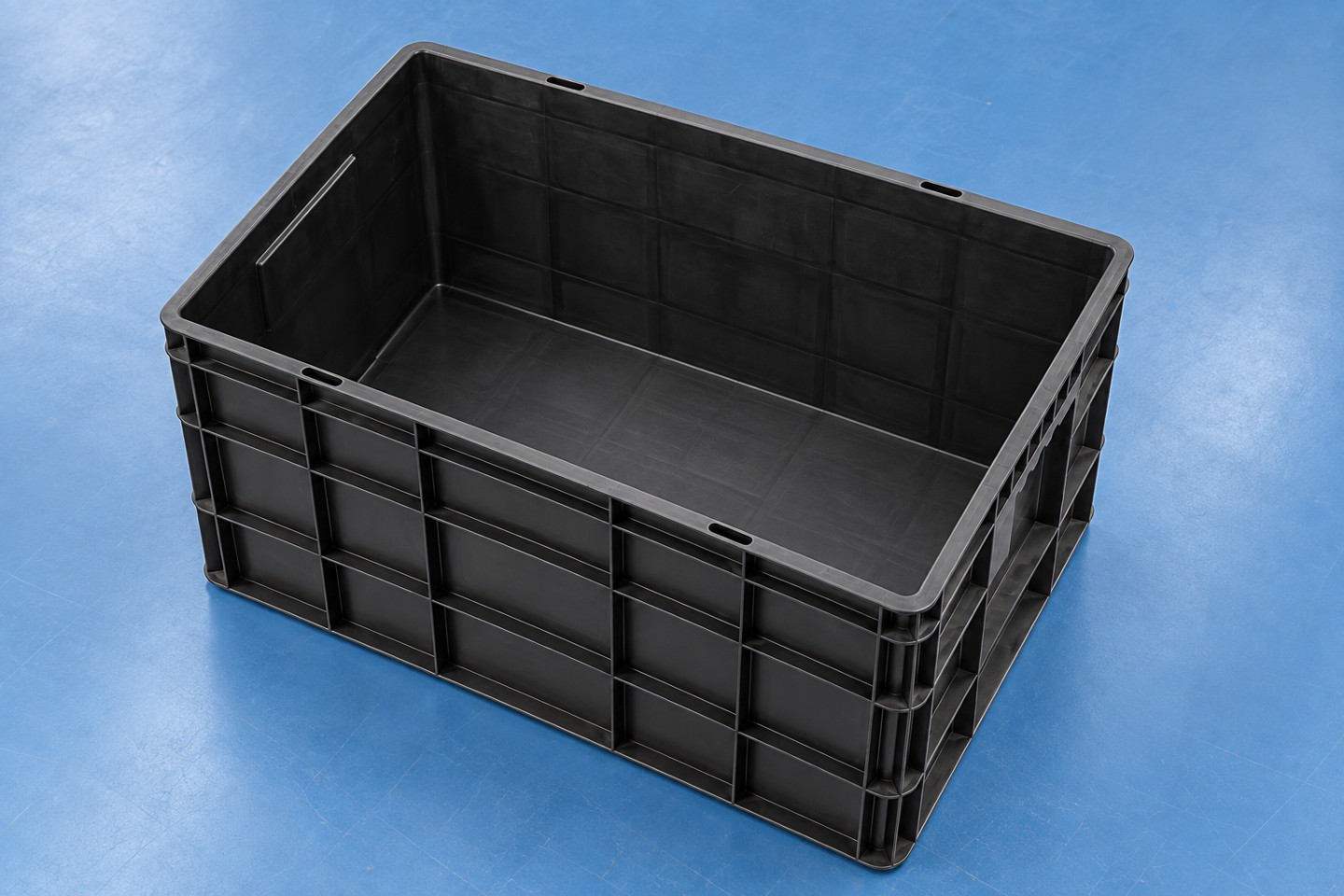
Build a test matrix around real use
Use the matrix below to separate test questions. It is not a standardized protocol and supplies no universal pass limits. Your packaging or mechanical engineer must choose the applicable procedure, loading level, duration and safe stop conditions before the trial. CCOHS storage-layout guidance provides background on arranging storage to reduce awkward reaches and manual handling.
| Test question | Configuration to define | Evidence to retain |
|---|---|---|
| Payload support | Approved contents, contact areas and base support | Loading drawing, supported surfaces and initial sample condition |
| Handle use | Whether lifting by the proposed handles is permitted | Supplier conditions and the agreed handling sequence |
| Stack compression | Actual lids, mating interfaces and approved stack layout | Stacking procedure, loading arrangement and restrictions |
| Equipment transfer | Representative shelf, carrier or conveyor supports | Contact geometry and compatibility findings |
| Condition after use | Inspection points and agreed measurements | Before and after observations with units and sample identity |
| Electrical control | Actual materials, accessories and site test procedure | Separate applicable electrical verification results |
Include the relevant route steps rather than repeating one static bench test. A container may experience a full supported base at receiving, two edge supports on storage equipment and a handle lift during replenishment. Those differences change the mechanical questions. When several approved routes exist, document which are covered by the sample evaluation. An acceptance record that identifies its limits is more useful than a general statement that the tote is heavy duty.
Represent the actual load distribution
Use the actual approved inner packaging or a representative arrangement accepted by the responsible engineer. A dense fixture touching the base at small points is different from uniformly distributed sealed packages. Mark the loading layout in the record and include photographs showing contact areas. If mixed products are permitted, evaluate the relevant worst configurations selected by engineering, not merely a convenient evenly filled demonstration. Define what may be placed against the walls and what must remain clear of the rim.
Protect sensitive products during any trial. Do not use valuable exposed assemblies as improvised weights. Where representative samples are used, state how they reproduce the mass, contact geometry and distribution being evaluated. This is also a useful moment to check labels, inserts and lids for interference. A lid that closes on an empty tote may press on a package after a liner is added. Resolve those fit problems before proceeding with a loading sequence.
Decide what to inspect and when
Define the inspection points before the test starts. Depending on the agreed protocol, they may include changes in base shape, rim condition, handle integrity, lid closure and fit with the intended supporting equipment. Record the initial condition and the condition after the specified steps. Use the measurements and instruments selected by the engineer, with clear units and locations. Do not accept the tote solely because it has not visibly broken at the end of an informal trial.
Stop conditions should protect people and the test area. A trial involving elevated or stacked loads needs an approved arrangement that controls collapse and falling-item hazards. Keep observers away from the load path and follow the facility’s safety procedures. This article does not authorize overload testing on production shelves. When the supplier’s documented procedure is unavailable or does not cover the intended use, arrange an appropriate evaluation instead of escalating the load until the box fails.
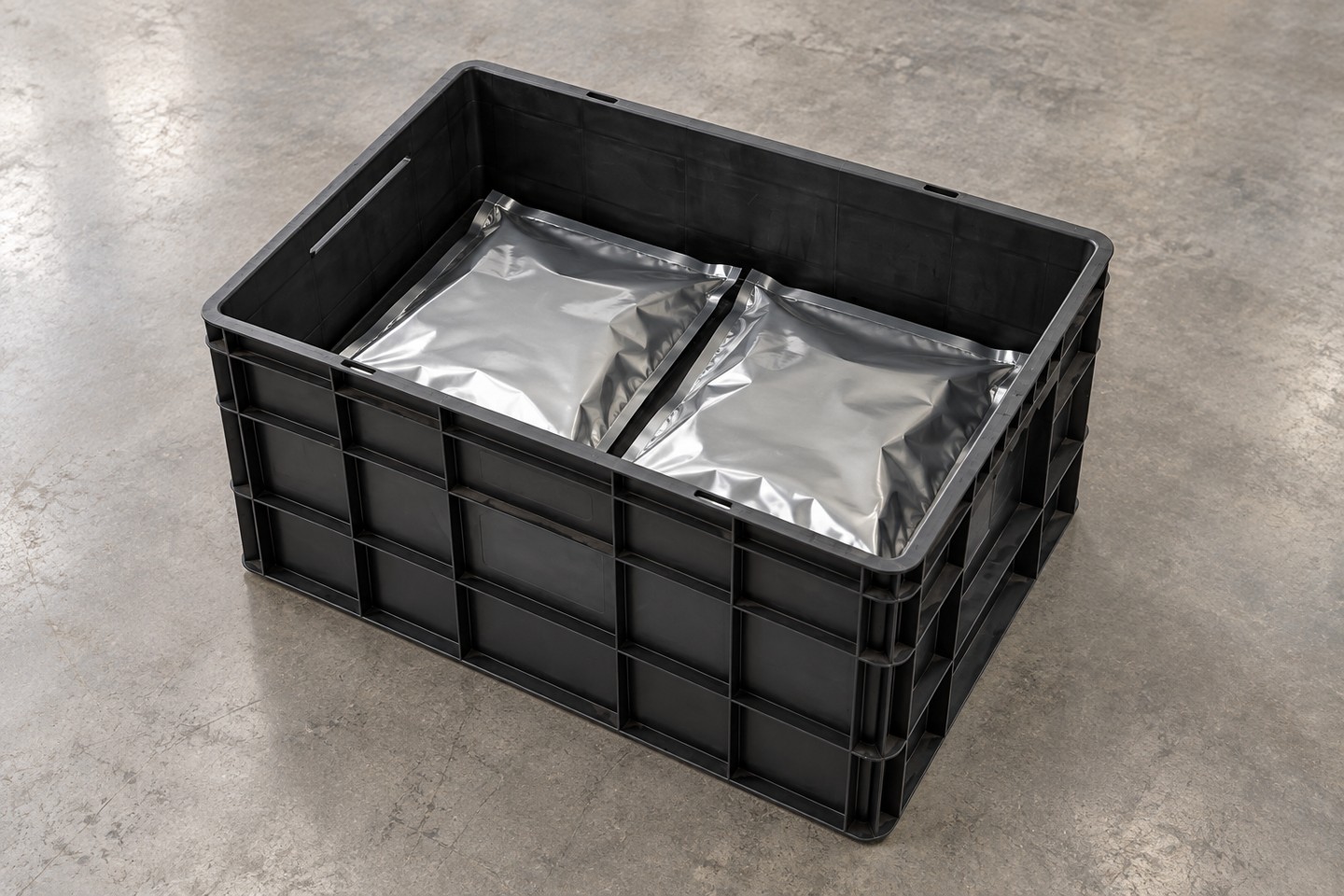
Review the stacking arrangement as a separate assembly
If stacking is allowed, record the actual lids, mating surfaces, load distribution and stack arrangement. Check whether the supplier’s evidence concerns filled or empty containers and whether a particular orientation is required. A tote with a deformed rim may no longer mate correctly even when its base still supports contents. The stack must be evaluated within the approved conditions; an arbitrary extra layer cannot be justified by the strength of one individual sample.
Storage and transport may require different arrangements. A stack that is acceptable in a static storage location is not automatically suitable for movement on a trolley or shipment to another facility. Consider the complete package system and its restraint under the relevant protocol. The interfacility shipping-box guide covers route and packaging decisions that extend beyond the capacity of a single tote.
Keep ESD verification independent of mechanical acceptance
Mechanical loading can alter surfaces, contacts or accessories, so determine whether the accepted verification sequence includes electrical checks before and after the relevant use conditions. Use the site’s approved procedures and limits rather than inventing a resistance target for every tote. The EOS/ESD Association’s basic procedures and materials guidance describes the role of packaging and material handling containers in an ESD control program.
The inner package also matters. A container’s conductive or dissipative description does not establish that the packed arrangement provides discharge shielding outside an EPA. Test evidence should identify what was assessed and which function it supports. If a liner, label or repair is changed after qualification, review the effect on the accepted arrangement. The ESD material selection guide helps separate those material questions from mechanical capacity claims.
Turn the result into an operating instruction
The release record should identify the tote model, accepted loading layout, permitted support conditions and restrictions. Explain how operators recognize damage and where suspect containers are isolated. Do not publish a new capacity label based on an undocumented local trial. Purchasing should retain the supplier’s evidence and the site’s additional evaluation so future orders can be checked against the same accepted model and configuration.
Where the trial finds a weakness, address the cause before retesting. The answer may be a different container, a better supporting arrangement, reduced approved loading or a revised inner package. Document which change was made and repeat the affected checks. This keeps the result actionable: the factory learns how the tote may be used safely and consistently rather than merely collecting a pass statement without a reproducible setup.
Further learning: material handling systems
The NPTEL lecture below explains how storage and movement fit into a material handling system. It is useful context for identifying route conditions; it does not set the tote’s rated capacity or replace an agreed mechanical test procedure.
Educational video: Lec 27: Material handling systems, NPTEL IIT Guwahati.
Sık sorulan sorular
Does a static load trial establish a maximum rating?
No. It evaluates the agreed conditions and criteria. A new maximum rating requires appropriate documented engineering evidence.
Can a stacking rating be used as a payload rating?
They describe different loading conditions. Ask the supplier what each figure covers before using it in an operating instruction.
Should the lid be included in the trial?
Include it when the approved use or supplier evidence depends on that lid and stacking interface. Record the exact configuration.
Can sensitive assemblies be used as test weights?
Protect actual products and use representative samples accepted by the responsible engineer when appropriate. Do not improvise a hazardous loading test.
Does mechanical acceptance prove ESD performance?
No. Verify the relevant electrical and packaging properties separately under the site plan and the actual handling route.


Bir Yorum Bırakın