- Турбо
- Блог
ESD trolley wheels should be selected as part of the complete trolley, floor and load system. Confirm electrical behavior through the assembled path, then verify wheel capacity, mounting, rolling effort, braking and compatibility with the site's cleaning and contamination requirements. Color and an “antistatic” label are insufficient evidence. For SMT floors and cleanrooms, the right wheel must suit the actual route and approved environmental conditions. This guide focuses on wheel selection and replacement evidence; it does not assign an electrical limit, cleanroom class or load rating to the pictured SWESD trolley without supporting test data.
Define the floor and transport route first
Map the complete route from storage to the receiving station. Record floor materials, joints, thresholds, slopes, door openings and parking locations. Note whether the trolley remains inside an EPA or crosses other areas. Include both the empty and loaded travel conditions. A smooth laboratory floor trial can miss the joint where a loaded trolley becomes difficult to steer or where one wheel loses effective contact.
Talk to the floor owner about permitted wheel materials and cleaning agents. A tread that marks one floor may be acceptable on another, while a cleaning product may leave residue that affects friction or electrical behavior. Do not solve a rolling problem by changing wheels before understanding these constraints. Keep the route definition in the RFQ and acceptance record so later replacement wheels are evaluated against the same conditions rather than bought only by diameter.
Specify the complete caster assembly
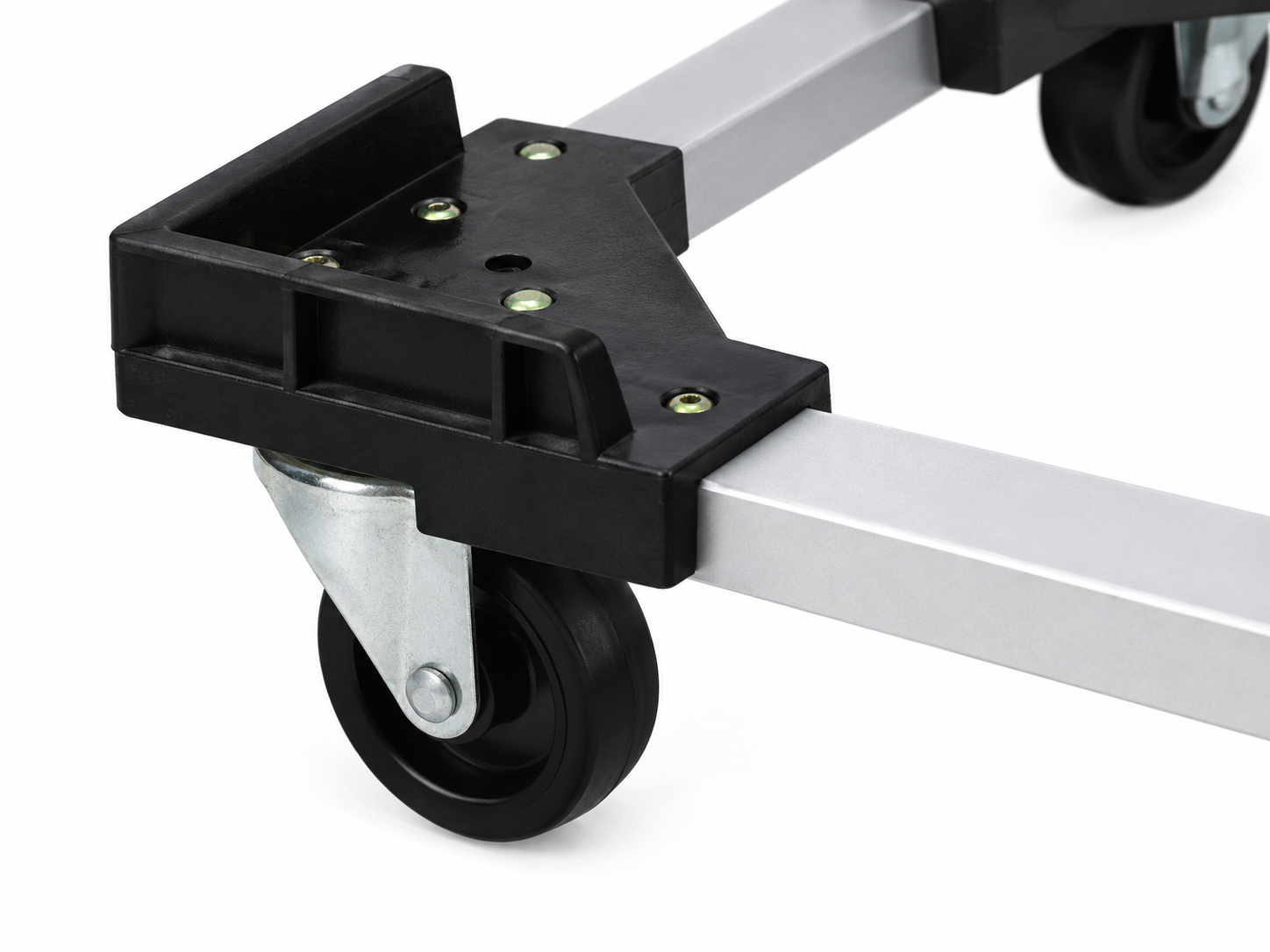
A caster includes more than its tread. Identify wheel diameter and width, axle arrangement, bearings, swivel mechanism, mounting plate or stem, installed height and any brake. Confirm the assembly's rating and dimensional fit to the trolley. Changing installed height can affect clearance, stability and the way a container meets a workstation. A wheel that fits an axle may still create an unsuitable caster assembly if its width or bearings differ.
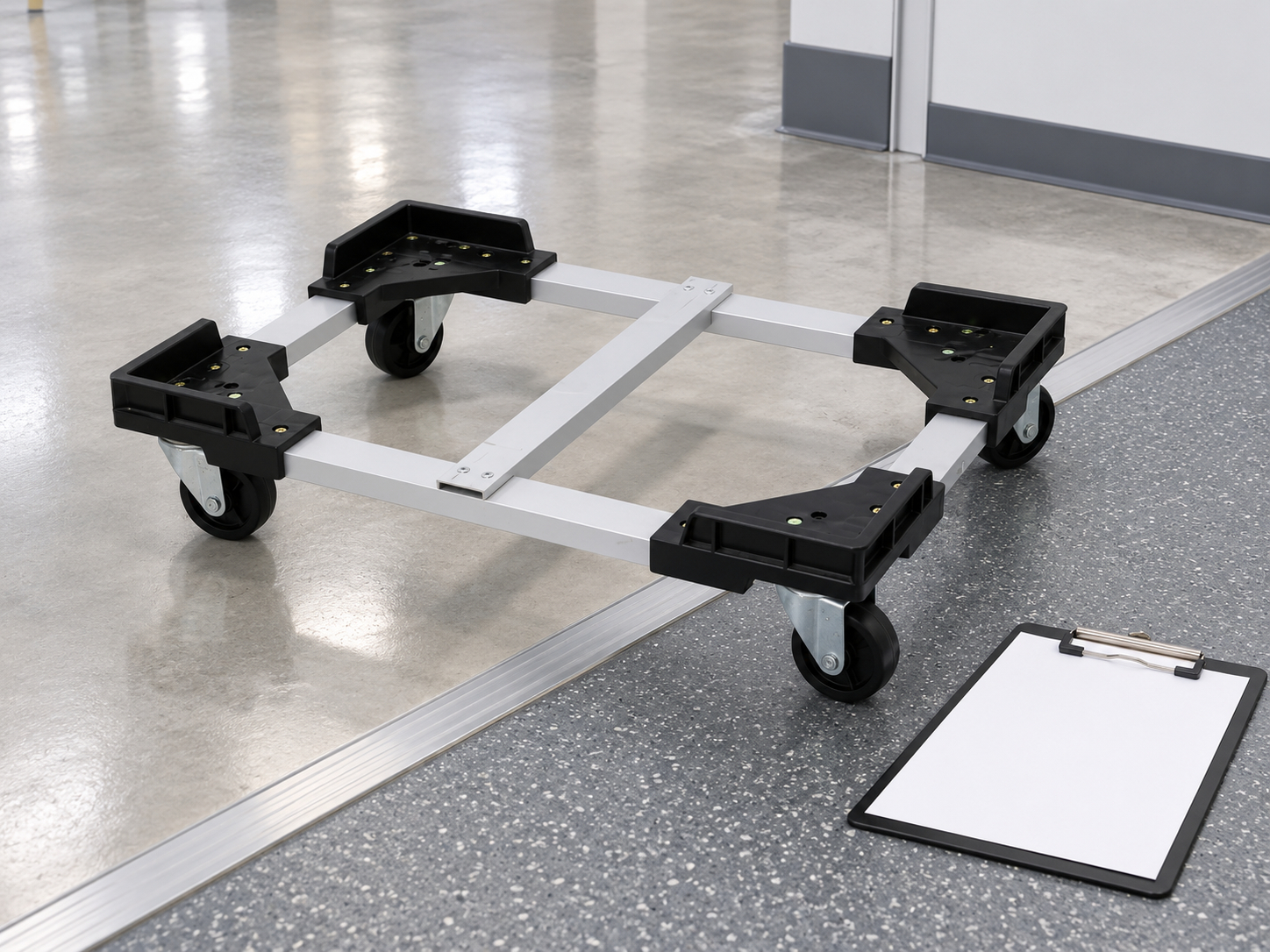
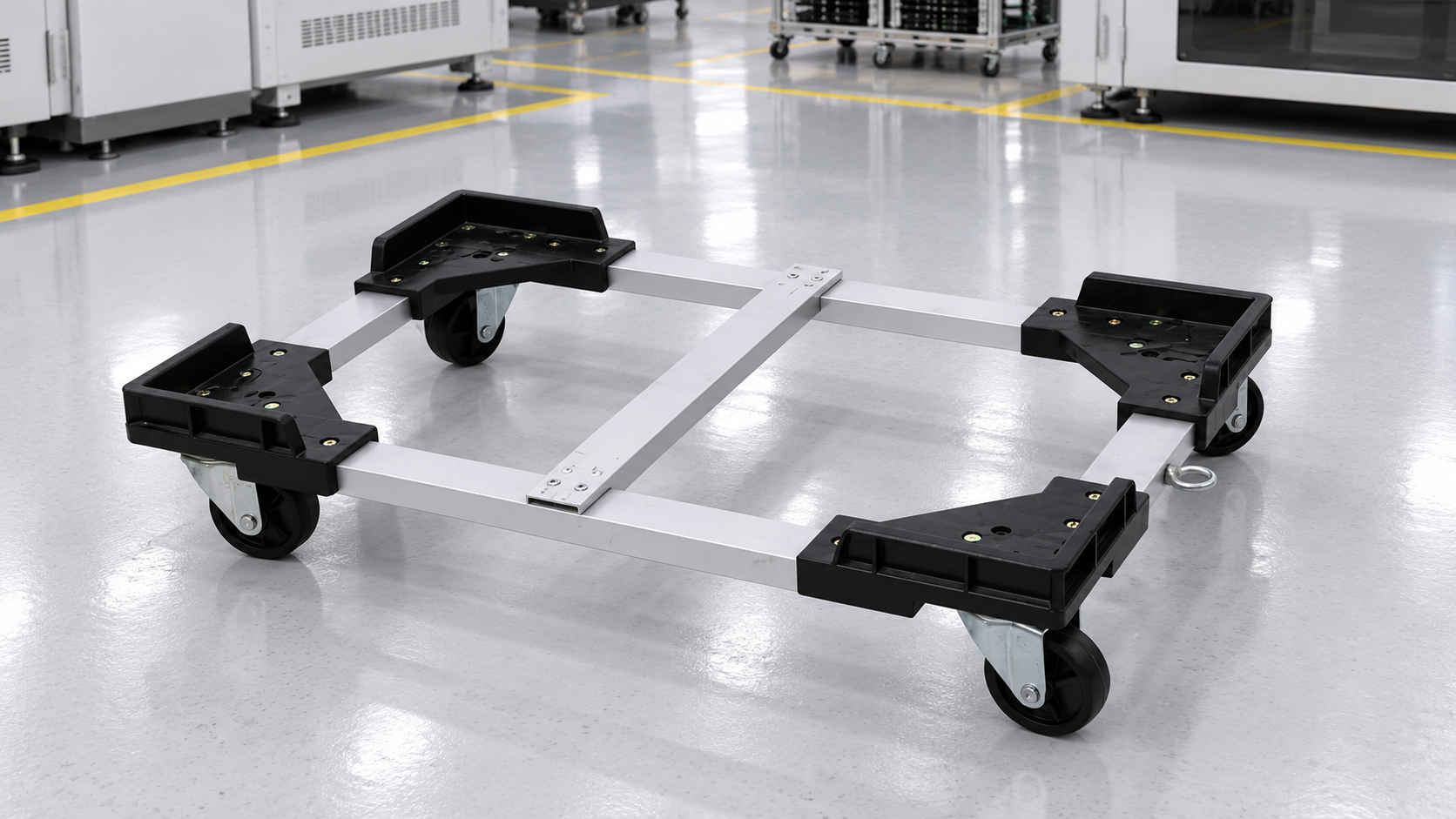
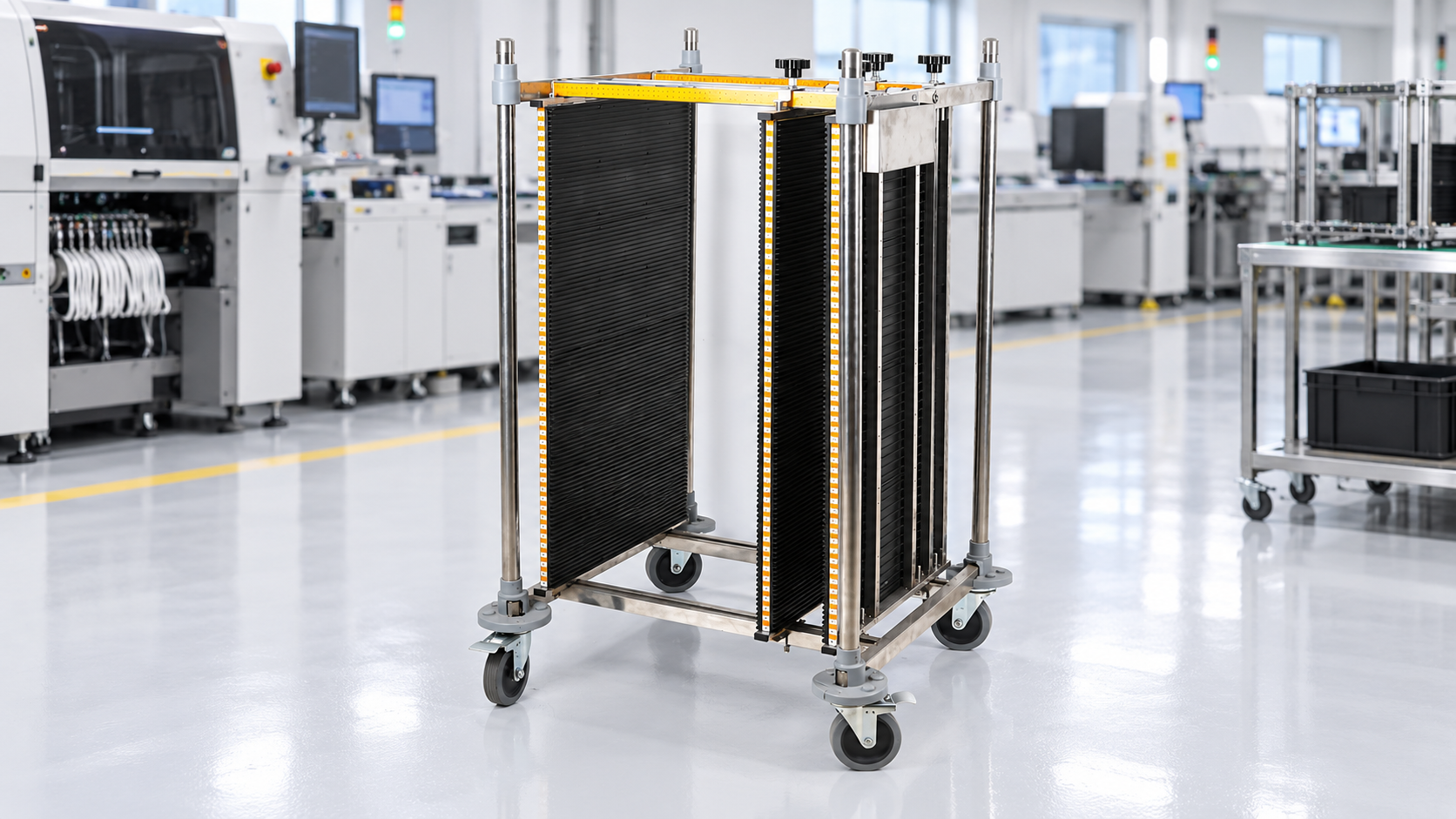
Земля SWESD low-profile trolley reference shows the real base and caster arrangement used in the illustrations. It establishes a visual reference, not proof of a specific tread compound or cleanroom qualification. Request the exact supplied caster identification and controlled drawing. For a general explanation of the trolley's role, see what an ESD trolley is; the selection here addresses the wheel and floor interface in detail.
Verify electrical behavior beyond the tread
The electrical path may involve the supported container, trolley frame, joints, caster hardware, tread and floor. Every relevant contact must meet the site's approved control method. Do not assume a conductive tread can compensate for an insulated mount or an unsuitable floor. The EOS/ESD Association's control-material guidance provides the grounding and material-control context. Its principles should inform a documented test plan, rather than being converted into an unsupported rating for a particular wheel.
Ask the ESD program owner which measurement applies to the assembled trolley and when it is performed. Record the instrument, electrode arrangement, conditioning, floor condition and acceptance limit from the approved plan. Separate supplier wheel data from system verification. Black tread is not proof of conductivity, and nonmarking tread is not proof of ESD suitability. Recheck after replacing casters, changing floor finishes or applying a different cleaning process where those changes affect the approved path.
Match rolling behavior to the real load
Confirm the loaded trolley's rating and the caster's rated conditions. Wheel diameter, tread hardness and bearing arrangement affect how the cart responds to the route, but no single attribute makes a wheel universally best. Larger wheels can require changes to clearance and installed height. Softer tread can behave differently under sustained load or with cleaning chemicals. Ask the supplier for evidence on the intended floor and duty rather than selecting from appearance.
Trial start, straight travel, turns, controlled stops and parking with the approved load. Include normal floor joints and the tightest permitted maneuver. Record steering effort and any vibration or load movement. If force is measured, use a defined instrument and procedure; do not invent a universal push-force threshold. OSHA's materials handling provisions support clear passageways and stable handling arrangements, but the actual wheel and trolley acceptance limits must come from their responsible design and safety owners.
Treat cleanroom suitability as a separate requirement
Ask the contamination-control owner what matters for the process: particle shedding, abrasion, lubricant migration, residue, chemical compatibility or cleaning access. An ESD wheel may still be unsuitable for a controlled environment. “Cleanroom compatible” should identify the tested assembly, conditions and required environment; it is not established by white tread or a product photograph. Bearings and swivel hardware may be as relevant as the visible wheel surface.
Review how the trolley is cleaned and stored. Dirt embedded in tread can be carried between areas, and debris around the axle may interfere with rolling. Define approved cleaning materials and drying conditions with the supplier and site owner. Do not apply an unverified solvent or spray lubricant as a routine solution. If an area requires a dedicated trolley, wheel changes alone may not make a shared cart acceptable. The whole transfer process must satisfy the contamination-control plan.
Compare candidates using a decision table
| Selection requirement | Доказательства для запроса | Site verification |
|---|---|---|
| Electrical suitability | Exact caster identification and test conditions | Complete assembly path under the approved ESD method |
| Load and movement | Assembly rating, speed and floor conditions | Loaded start, turn, stop and joint crossing trial |
| Installation | Mounting, installed height and fasteners | Fit, level and clearance after installation |
| Contamination control | Material, lubrication and cleaning compatibility | Acceptance by the contamination-control owner |
| Parking | Brake type and permitted operating conditions | Stable parking with the approved load |
| Replacement | Controlled part and revision record | Mechanical and affected electrical checks after change |
Keep supplier declarations and site trial results in separate columns of the purchasing record. A passed check at one load or floor condition has a defined scope. NIST's terminology for measurement conditions helps explain why repeated checks need consistent methods. The table provides qualitative decision points; it does not set numerical resistance, particle or mechanical limits without the site's approved requirements.
Check brakes and swivel layout together
Document which casters swivel, which are fixed and which have approved brakes. Confirm that the arrangement allows the intended steering and parking behavior. Replacing one fixed caster with a swivel caster can change handling even if its wheel rating is higher. A total-lock function and a wheel-only brake are different arrangements; ask the supplier to identify the actual mechanism and permitted use. Operators should not have to hold a loaded cart in place while handling boards.
Keep the parking surface and loaded height in the trial. Verify that the trolley stays stable while containers are removed from the approved positions. Do not use a parking brake to justify operation on an unapproved slope. Wheel selection cannot correct an overhanging load or a weak frame. The trolley load-capacity guide addresses those structural and distribution requirements, which must be approved alongside the selected caster system.
Plan replacement without losing the accepted configuration
Record the accepted caster part number, mounting dimensions, fasteners and installation instructions. Inspect tread damage, flat spots, looseness, swivel binding and brake function at the intervals defined by the site's duty and risk. A wheel may still rotate while delivering poor handling or an unsuitable electrical path. Do not wait for complete mechanical failure when inspection identifies a safety or ESD concern.
After replacement, check assembled height, level, fastener security, rolling behavior, braking and affected electrical properties. Repeat environmental checks where the replacement material or lubrication changes them. Keep the service date and replacement revision in the record. The ESD trolley maintenance checklist provides a complementary inspection framework. Replacement approval should establish equivalence to the accepted assembly; merely ordering another wheel described as ESD does not demonstrate that equivalence.
Give suppliers enough information for an honest recommendation
Send the complete trolley drawing, payload, load distribution, floor description, joints, speed, duty, required mounting and installed height. Add the ESD test requirements and any contamination-control or cleaning constraints. Request documentation for the exact caster assembly, including test conditions and limitations. Ask for samples and a controlled trial before standardizing the part across multiple carts.
Compare candidates using the real cost of movement, cleaning, maintenance and replacement. A low-price wheel that needs frequent replacement or causes difficult steering can increase handling cost, while an oversized wheel can introduce unwanted height changes. Keep the decision grounded in measured trial behavior and documented compatibility. Require notification when tread compound, bearing, brake or mounting design changes, so the site can reassess the affected checks before introducing a new revision into production.
Compare a replacement sample with the installed wheel
Photograph the old and proposed assemblies together and compare mounting pattern, tread width, installed height and brake access. Check that the replacement does not interfere with a corner support or require an improvised spacer. Ask why the existing wheel failed before accepting an apparently stronger substitute: contamination, a floor joint, an overloaded cart and a damaged mount require different corrective actions. Keep the rejected part for examination when appropriate. A controlled comparison reduces the chance that maintenance fixes rolling movement while introducing a different height, stability or electrical problem elsewhere in the assembly.
Further learning: ESD control principles
The EOS/ESD Association's university lecture below explains ESD fundamentals and why control measures must work together. It provides background for the trolley-to-floor electrical discussion; it does not certify the illustrated wheels or replace assembly-level verification.
Часто задаваемые вопросы
Are black wheels automatically conductive?
No. Color does not establish electrical behavior; request documented properties and verify the complete assembly under the site plan.
Are ESD wheels automatically suitable for cleanrooms?
No. Contamination control, material, lubrication and cleaning requirements need separate evidence and site acceptance.
Can a larger wheel be installed without other checks?
No. Confirm mounting, installed height, clearances, stability, braking and the complete rated assembly before approving the change.
What should be checked after replacing casters?
Check level, mounting security, movement, parking and affected electrical and environmental properties against the accepted configuration.
Can conductive tread compensate for unsuitable flooring?
No. The relevant assembly and floor path must meet the approved control requirements for the actual route.
Оставить ответ