- Turbo
- Blog
ESD field service packaging for spare parts should keep a replacement electronic assembly identified and protected from dispatch until the technician can open it under the approved handling conditions. Specify the inner protective package, mechanical support, outer shipping container and return instructions as separate functions. A reusable tote can organize service kits, but its color or conductive description does not prove discharge shielding during transport. Evaluate the complete route, including customer receiving and unused-part returns. This guide concerns service inventory and logistics, not a claim that every repair location is an ESD protected area.
Map the service route before choosing a box
A spare part may move through a central warehouse, a regional service location, a vehicle and a customer site before use. Identify which points provide controlled handling and where the package must remain closed. Include waiting and repeated movement, not only the main shipment. A kit that is suitable inside the factory can become unsuitable when the same container is opened at an uncontrolled service counter or reused for an unfamiliar product.
Determine who has authority to open the protective package and what instructions they need. If the destination lacks the required controls, define how the sensitive item remains protected until an approved handling arrangement is available. Do not assume the outer tote makes every workspace safe. The EOS/ESD Association’s ESD control principles provide the relevant distinction between packaging used inside and outside an EPA.
Keep inner electrical protection and outer support distinct
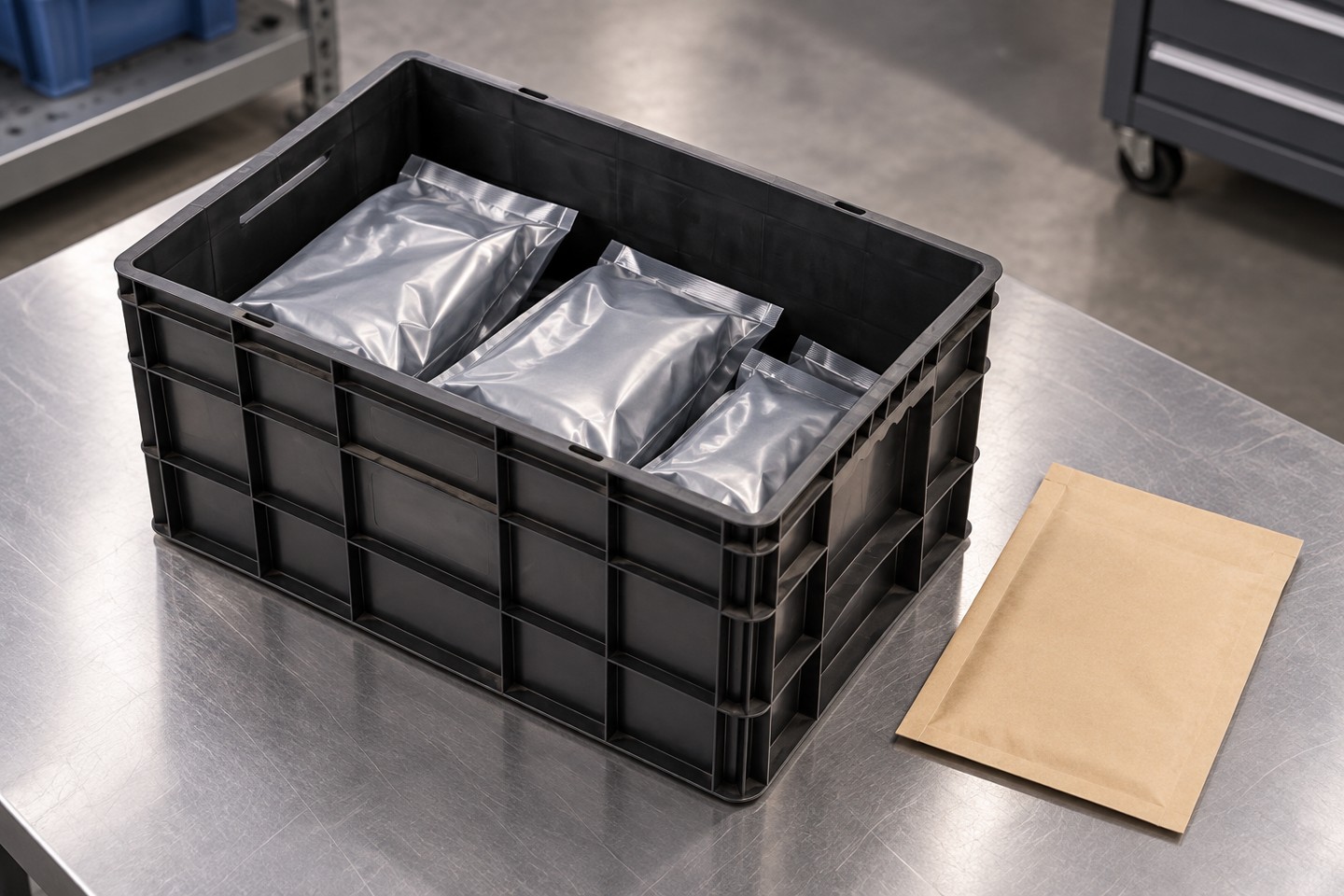
Specify the product’s required inner package and closure using the responsible engineering or service instruction. Ask for the relevant evidence when a supplier proposes shielding or other protective properties. A bag that looks silver is not proof of the required performance. Its size, closure and compatibility with the actual assembly also matter. Avoid forcing a board into a package that folds vulnerable projections or leaves the closure unable to function as intended.
The outer container then supports the protected package and the shipment route. It may provide organization, cushioning or impact protection under the qualified arrangement. Those functions should be assessed separately from the inner package’s electrical properties. For a tote reference, see SWESD’s ESD box, and request the exact supplied configuration rather than assuming the illustration demonstrates a tested service shipping kit.
Build a kit around the actual service operation
Decide whether the kit contains one replacement module, several alternative parts or tools and consumables as well. Keep items that could damage the protected package separated through an approved layout. A loose tool beside a bagged assembly can create a mechanical risk even when the tote is ESD suitable. Do not place metal tools, fasteners or documents directly against sensitive product surfaces to save space.
Allow the technician to identify the correct spare without opening every protective package. Link the part number, revision and service applicability to the load record and the visible package identification. Avoid replacing the manufacturer’s required identification with a container-level label alone. The box labeling guide explains how container identity and changing contents should remain distinct during reusable logistics.
Confirm responsibilities at each service handoff
Use the following checklist to define who performs each action. It is a workflow aid rather than a shipping certification. The accepted package must meet the actual product, customer and route requirements established by the responsible teams.
| Service handoff | Required decision | Evidence or instruction |
|---|---|---|
| Warehouse dispatch | Correct part, revision and accepted package | Load record and complete packing configuration |
| Regional receiving | Package condition and service allocation | Action for torn, open or uncertain protective packaging |
| Technician identification | How to select the spare without opening every package | Visible part information and applicability record |
| Opening | Where required handling controls are available | Approved opening sequence and exception response |
| Unused return | Whether the package stayed accepted and identifiable | Separate release rule from failed-product returns |
| Removed assembly return | Identity, status and protective arrangement | Preserve the service incident information and segregate suspect material |
Include a controlled response to damaged or uncertain packaging. Receiving staff should know where to isolate the shipment and which evidence to preserve. A technician should not guess whether a torn or unsealed protective package remains acceptable. Keep the replacement decision and the packaging investigation linked when the incident could affect product condition, while avoiding unsupported conclusions about the cause of an electrical failure.
Check mechanical support and access together
Use the actual approved package in the fit evaluation. Include projecting connectors, accessory packs and any cushioning or insert. Demonstrate how the technician removes the correct item without dragging it against the outer container or gripping a vulnerable feature. The package should remain readable and its closure undisturbed until the approved opening step. An arrangement that looks neat during packing may still make safe removal difficult.
Select the transport evaluation with the responsible packaging engineer. Record the complete configuration, loading pattern and applicable protocol. Do not assign a drop height or claim a universal protective performance based on a photograph. The ESD bin liner guide explains why cushioning, separation and inner packaging serve different purposes. Use only the evaluated combination for the service route and control substitutions of foam, film or dividers.
Include moisture and cleanliness only when applicable
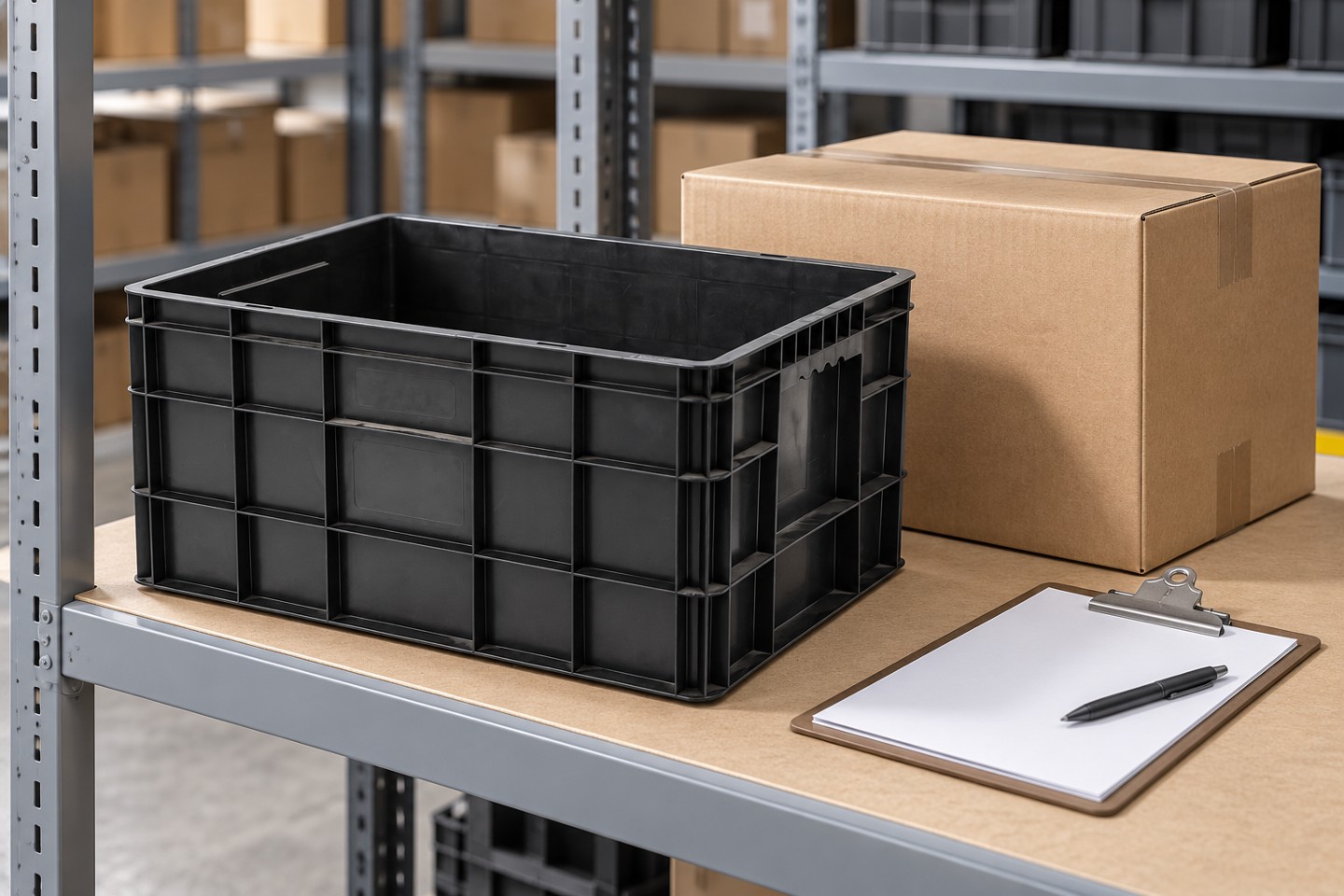
Some parts have handling requirements beyond ESD control. Obtain the product’s instructions and determine whether moisture protection, cleanliness or environmental storage limits apply. Keep those requirements separate from the outer tote’s description. Do not advertise every ESD box as moisture controlled or cleanroom approved without the relevant evidence for the exact supplied product and use.
Service stock can remain in storage longer than production material, so check the required package inspection and handling rules during that period. Decide who monitors conditions and what happens when a package is opened, damaged or returned unused. Do not invent a shelf life or a rebagging procedure from general assumptions. The product owner or responsible engineering team must define the permitted actions.
Keep unused spares and returned failures separate
An unused replacement part, an opened package and a removed failed assembly are different return categories. Define the required identification and packaging for each one. Do not put a suspect returned board into the same available-stock container as a sealed new spare. Preserve the service record needed to understand the returned item and keep any evidence that could support the failure investigation.
If reusable containers circulate between the warehouse and service locations, establish who inspects and releases them before another load. The returnable ESD packaging pool guide covers that outer-container process. A returned tote may need cleaning, repair review or accessory replacement even when the service part itself is no longer inside. Keep these release steps visible in the record.
Train the opening and repacking sequence
Provide a short illustrated instruction that identifies the package to keep closed, the approved opening conditions and the sequence for handling unused material or returned assemblies. Include what the technician should do when the instruction or required controls are unavailable. Avoid relying on a generic ESD symbol to communicate all of these decisions. Training should match the kit and service task actually performed.
The EOS/ESD Association’s basic procedures and materials guidance provides background on handling and protective materials. Use it alongside the specific service instruction, not as a substitute for product-level requirements. Verify the instruction with a representative technician so unclear labels, inaccessible packages or unrealistic repacking steps are found before the kit is released.
Prepare a service-packaging RFQ
Send the supplier the product envelope, approved inner package, service kit contents, route and return categories. Request a complete proposed arrangement with its material identities, evidence and replacement items. Clarify whether the quotation includes lids, inserts, individual packages, labels and outer shipping cartons. Ask for a representative sample and evaluate it through dispatch, receiving, identification, opening and return.
Record the accepted configuration and ensure repeat supplies match it. Keep commercial promises, delivery terms and qualification evidence distinct. A supplier may provide a suitable outer tote while the inner package comes from another approved source; the complete kit still needs a controlled specification. The useful result is a package that lets the correct spare arrive identifiable and protected, with a return process the technician can actually follow.
Further learning: ESD controls outside the factory
The EOS/ESD Association educational lecture below explains the principles behind handling sensitive electronic devices. It provides context for keeping a service package closed until the required controls are available; it does not certify the complete shipping kit.
Educational video: Introduction to ESD as part of University Lectures, EOS/ESD Association, Inc..
Soalan Lazim
Does an ESD tote replace the inner protective package?
Only if the approved product specification and qualification support that arrangement. Conductive appearance alone does not establish discharge shielding.
Can service spares be opened at any customer counter?
Open them only under the handling conditions required by the product instruction. Otherwise keep the approved protective package closed.
Should failed boards and unused spares share one return bin?
Keep their identity and status controlled separately so suspect material cannot rejoin available service stock inadvertently.
Are moisture requirements covered by an ESD label?
No. Obtain and follow any separate moisture, cleanliness and storage requirements for the actual component or assembly.
What should a service kit sample trial include?
Demonstrate dispatch, receiving, identification, approved opening, removal and return using the actual protected package and a representative technician.


Tinggalkan Balasan