- ターボ
- ブログ
ESD foam density and firmness describe different properties and should be specified separately. Density is mass divided by volume; firmness describes a mechanical response measured under a defined loading procedure. Neither property alone establishes ESD performance, cushioning suitability or safe contact with a component. Buyers should identify the exact foam family and grade, request the relevant material and force-response evidence, and verify the complete insert with representative items. This guide explains how to read density data, avoid false comparisons and turn a general request for stronger foam into a measurable packaging specification.
Start with the function of the foam insert
Define whether the foam cushions a closed package, locates a component, supports a surface or separates already protected items. Record where the protected part can contact it and which surfaces need clearance. These functions can lead to different mechanical requirements. A material that feels pleasantly soft by hand may not provide the intended retention, while a very firm material may apply unwanted force to a delicate feature.
Review the insert with the whole carrier, lid and item. Note the loaded contact geometry and the permitted movement during handling. Do not begin by selecting a density number from an unrelated application and then design the package around it. The useful specification describes the support or retention requirement and asks for appropriate evidence, rather than assuming that a larger density value will always improve protection.
Read density as a material measurement
Density is calculated from the mass and volume defined by the selected procedure. Record the units and specimen preparation. For compressible or cellular materials, the method used to establish dimensions matters: an uncontrolled measuring force can change the apparent thickness. Ask the supplier which method, conditioning and specimen basis support the reported value, and whether it applies to the offered construction.
For a hypothetical calculation only, a specimen with a measured volume of 100 cubic centimetres and mass of 2 grams has a density of 0.02 grams per cubic centimetre, equivalent to 20 kilograms per cubic metre. These figures do not describe a SWESD product and are not a recommended specification. They illustrate the arithmetic and unit conversion. An actual result requires a suitable measurement procedure, traceable observations and the precision justified by the equipment and specimen.
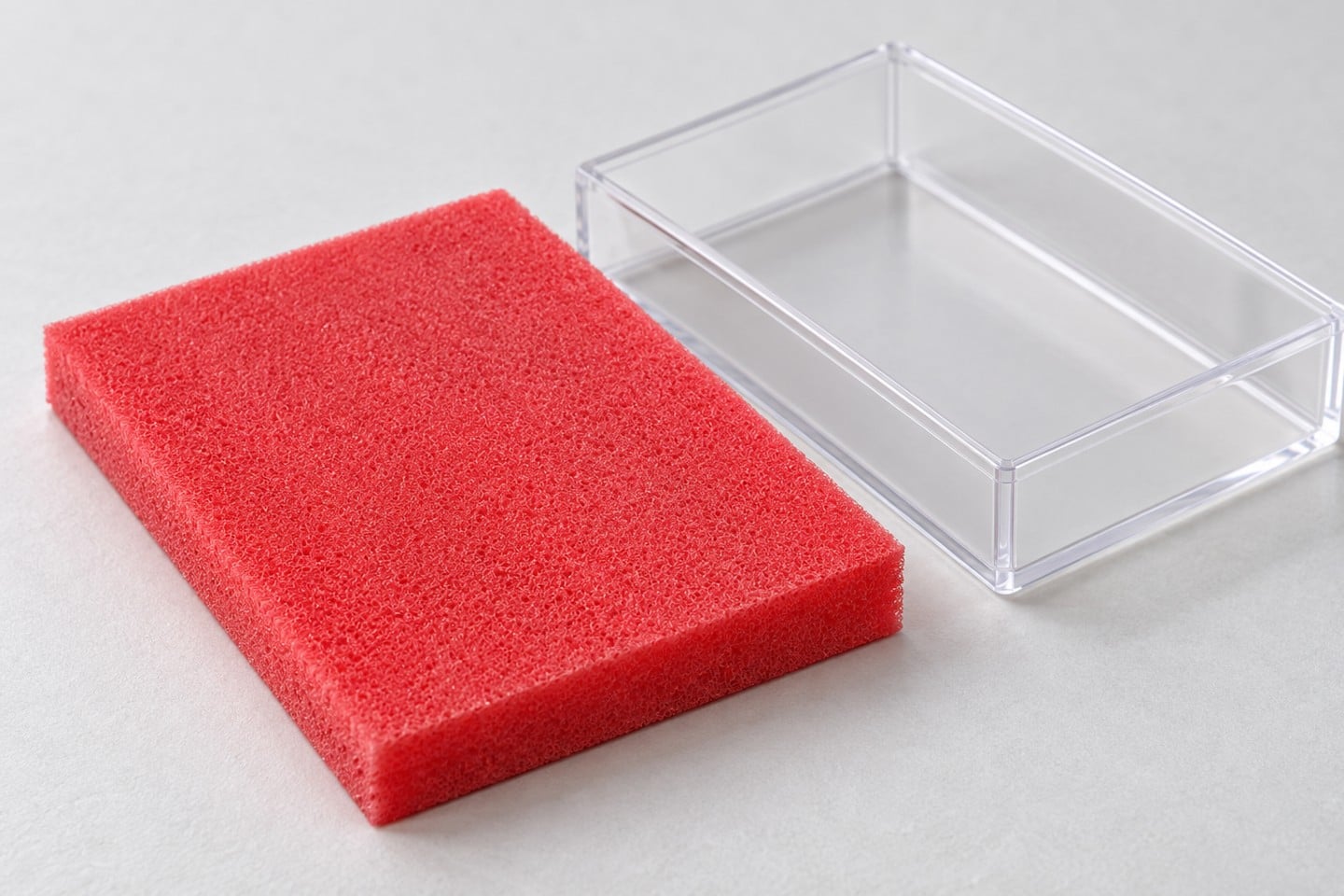
Distinguish density from firmness and load response
Two materials with similar density can have different mechanical responses because their polymer, cellular structure and construction differ. A density statement therefore cannot replace a specified force-response test. Ask what the supplier means by firmness, hardness or compression resistance, and request the procedure, specimen geometry and reported units. Similar marketing words can refer to different measurements and should not be treated as directly interchangeable.
その ASTM D3574 overview identifies a test-method family for flexible polyurethane foam. Its stated scope should not be extended automatically to every foam sold for ESD packaging. The ASTM D3575 overview concerns flexible cellular materials made from olefin polymers. A competent laboratory should confirm the applicable method and exact procedure for the actual offered material and design question.
Identify material, construction and finishing details
Request the exact polymer family, controlled grade, thickness, construction and product identity. The SWESD foam sheet range contains different material families; the range does not establish common density, firmness or electrical results. Ask which specification and report apply to the offered version. A shared color or family description is not adequate evidence that two samples are equivalent.
Record whether the insert is a single material, laminated stack, faced sheet or adhesive-bonded assembly. Machining, cavities and thin remaining walls can make its behavior different from a plain test specimen. If a sheet is used against a rigid carrier, describe that support. The material report and the completed insert trial answer related but different questions, and both should remain connected to the accepted drawing and revision.
| Property or input | What it describes | What it cannot establish alone |
|---|---|---|
| Density | Mass divided by defined specimen volume | Firmness, electrical behavior or package approval |
| Firmness or load response | Mechanical result under a specified procedure | A universal response across different methods |
| Construction | Material, thickness, layers and finishing | Equivalence based only on color |
| Application trial | Support and retention in the evaluated assembly | All future conditions or reuse cycles |
| Electrical evidence | The required ESD function under its method | Mechanical durability or chemical compatibility |
Request comparable reports rather than isolated numbers
A useful comparison includes material identity, method, specimen preparation, conditioning, units and the relevant result. Confirm that the candidates were evaluated under conditions that make the intended comparison meaningful. Do not rank one supplier’s density figure against another supplier’s force-response figure or treat a value without units as a complete specification. Ask for clarification before using the number in a purchase order.
If reports use different methods or specimen geometries, have the laboratory or materials engineer explain the limitations. Unit conversion alone cannot remove a procedural difference. Avoid creating an unsupported conversion between hardness, firmness and density. Where a common method is appropriate, request a controlled comparison on production-intent materials. Retain original data and deviations so that a favorable summary does not hide an important difference in how the samples were evaluated.
Evaluate the insert with representative geometry
Use approved samples or safe surrogates representing the relevant mass, shape and contact restrictions. Review whether the insert supports the intended surfaces, prevents unwanted movement and allows removal without excessive force. Check the closed package as well as the open tray. A lid can change the loading condition, especially where an insert is taller than the available space or a small feature carries a concentrated load.
Record the trial configuration, observations and acceptance criteria before release. Do not add extra layers during a trial without identifying the change. More foam can increase pressure or interfere with clearance. If the protected item changes, revisit the arrangement rather than assuming that the same nominal density solves the new requirement. The complete package must support the actual application, not merely reproduce a material value from a catalogue.
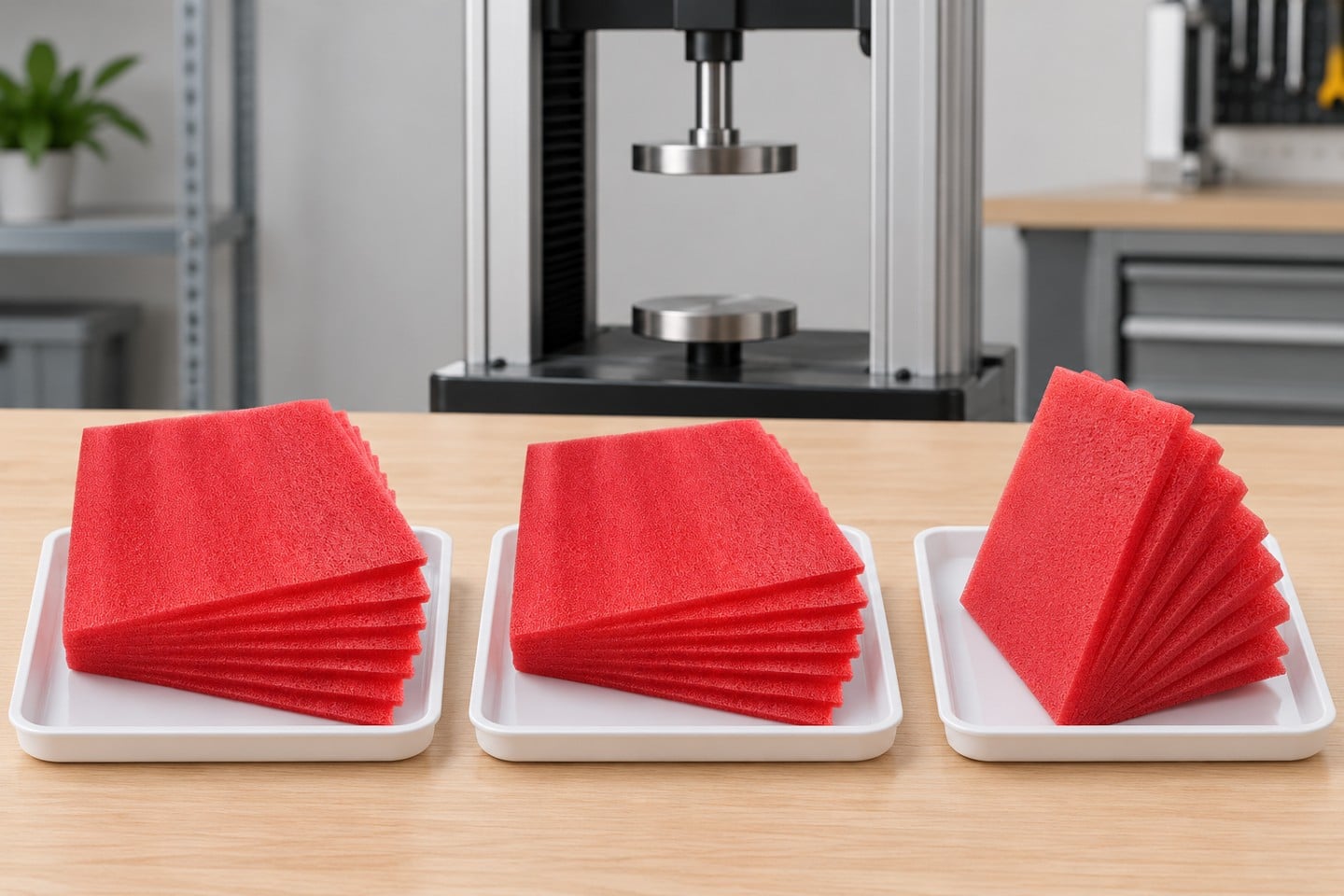
Keep repeated-use behavior separate from initial firmness
A fresh specimen’s response does not establish how an insert behaves after storage, repeated loading or an approved cleaning process. Ask which service conditions the supplier evidence covers. Review permanent deformation, tears, lost retention and contamination as the application’s rules require. Do not assign a universal cycle life from density alone or infer durability from an informal squeeze test.
その foam compression recovery guide addresses remaining thickness loss after a defined exposure and recovery sequence. It is complementary to density and firmness selection, rather than another name for the same property. Keep each measurement’s method and acceptance boundary clear. A successful initial fit may still need a separate repeated-use assessment before a returnable packaging arrangement is accepted.
Verify the required electrostatic function independently
その EOS/ESD Association materials overview describes packaging as part of a broader control program. Density and firmness do not establish charging behavior, electrical resistance or discharge shielding. Identify the foam’s protective role in the approved application and request the applicable evidence for the exact construction. A mechanical specification should not be allowed to substitute for an electrical one.
Also evaluate cleanliness and material compatibility where the process needs them. A dense or firm insert is not automatically low shedding or chemically suitable for a sensitive metal finish. The conductive foam RFQ guide helps organize those separate requirements. For a different carrier form, see the EVA tray guide, while avoiding unsupported transfer of material results between products.
Turn the selection into a controlled purchasing requirement
Provide the component or surrogate geometry, permitted contact, carrier arrangement, storage conditions and intended reuse. Request the exact material specification and the evidence needed for the design decision. State which density range or other property is required only after the responsible engineer has established its role and acceptance basis. Do not ask the supplier to select an arbitrary high density merely because the current package has a handling problem.
Define allowed variation, report requirements, sample approval and change notification. Link the purchase order to the accepted insert drawing and material identity. At receiving, verify the product and construction before comparing the relevant observations or reports. A visually similar substitute should not be accepted automatically, because the same color and nominal thickness can conceal a different mechanical or electrical arrangement.
Retain the decision and its limitations
Keep the material report, application trial and release decision together. Record rejected candidates and why they were unsuitable; this prevents a later substitution from repeating the same problem. Define which changes to the protected item, foam, adhesive, processing or cleaning will require review. The accepted configuration should be understandable without relying on the memory of the original buyer.
A good specification explains the job the foam must do and the evidence that supports its use. It does not claim that a density number alone predicts every aspect of packaging performance. Maintaining that distinction makes supplier comparisons more useful and keeps support, retention, durability, cleanliness and electrostatic protection attached to their own verifiable requirements.
Educational background
The EOS/ESD Association video below introduces electrostatic control. It does not measure foam density or firmness and does not establish a mechanical specification. Use the relevant material method and the approved application trial for those decisions.
よくある質問
Are higher-density foams always firmer?
Do not infer firmness from density alone. Compare the exact materials using relevant mechanical evidence.
Can density prove ESD suitability?
No. Charging, resistance and any required shielding functions need their own evidence.
Is the numerical density example a SWESD specification?
No. It is hypothetical arithmetic showing mass divided by volume and a unit conversion, not a product value or recommendation.
Can ASTM D3574 be used for every ESD foam?
Confirm the applicable method with the laboratory. Its published scope concerns flexible polyurethane foam, while other material families may need different methods.
What should be supplied in a foam RFQ?
Describe the item, permitted contact, carrier, use and storage conditions, required evidence and production-intent sample trial.

コメントを送信