- Turbo
- Blog
ESD box partitions for automotive electronics should separate approved product packages without loading connectors, contacting vulnerable components or confusing part identity. Start from the assembly drawing, allowed support areas and handling route, then define compartment size and retention. A divider is an organizing structure, not automatic evidence of cushioning, discharge shielding or automotive quality approval. Qualify the complete box, partition and inner package for the intended use. This guide concerns reusable container layouts for electronic assemblies; it does not claim that a specific SWESD container includes a partition accessory or meets a customer’s acceptance standard.
Start with the assembly rather than the box outline
Automotive electronic assemblies can include protruding connectors, heatsinks, mounting points and exposed circuit-board areas. Obtain the controlled product drawing and identify which surfaces may support the item. Do not choose compartment dimensions using only the overall length and width. Account for the actual protective package, orientation and access needed for removal. A compartment that barely accepts the nominal outline can become unsuitable when a connector projection or permitted packaging variation is included.
Ask engineering which features must remain unloaded and which may contact a support. A partition pressed against a connector can cause damage even if the box survives transport. Where an assembly must remain in an individual approved package, design the layout around that package rather than stripping it to gain space. Distinguish the carrier’s reusable structure from the product’s required packaging. Those decisions determine what the partition can legitimately do and which functions belong elsewhere.
Define one compartment's identity and loading rule
A compartment can hold one assembly, one protected package or a controlled quantity of smaller items. State the rule explicitly. Mixed compartments are difficult to audit when similar modules, revisions or customer allocations share the same container. Decide how the loaded position maps to the product record and how an empty position is handled. If the layout is symmetrical, make sure operators do not infer orientation solely from the shape of the outer box.
Do not assume a divider layout establishes first-in-first-out control. The replenishment and removal sequence must support the intended lot policy. When the same box is reused for a new part number, define how old identification is removed or invalidated. The component traceability guide discusses the inventory process; the partition drawing should make that process practical rather than creating inaccessible or ambiguous positions.
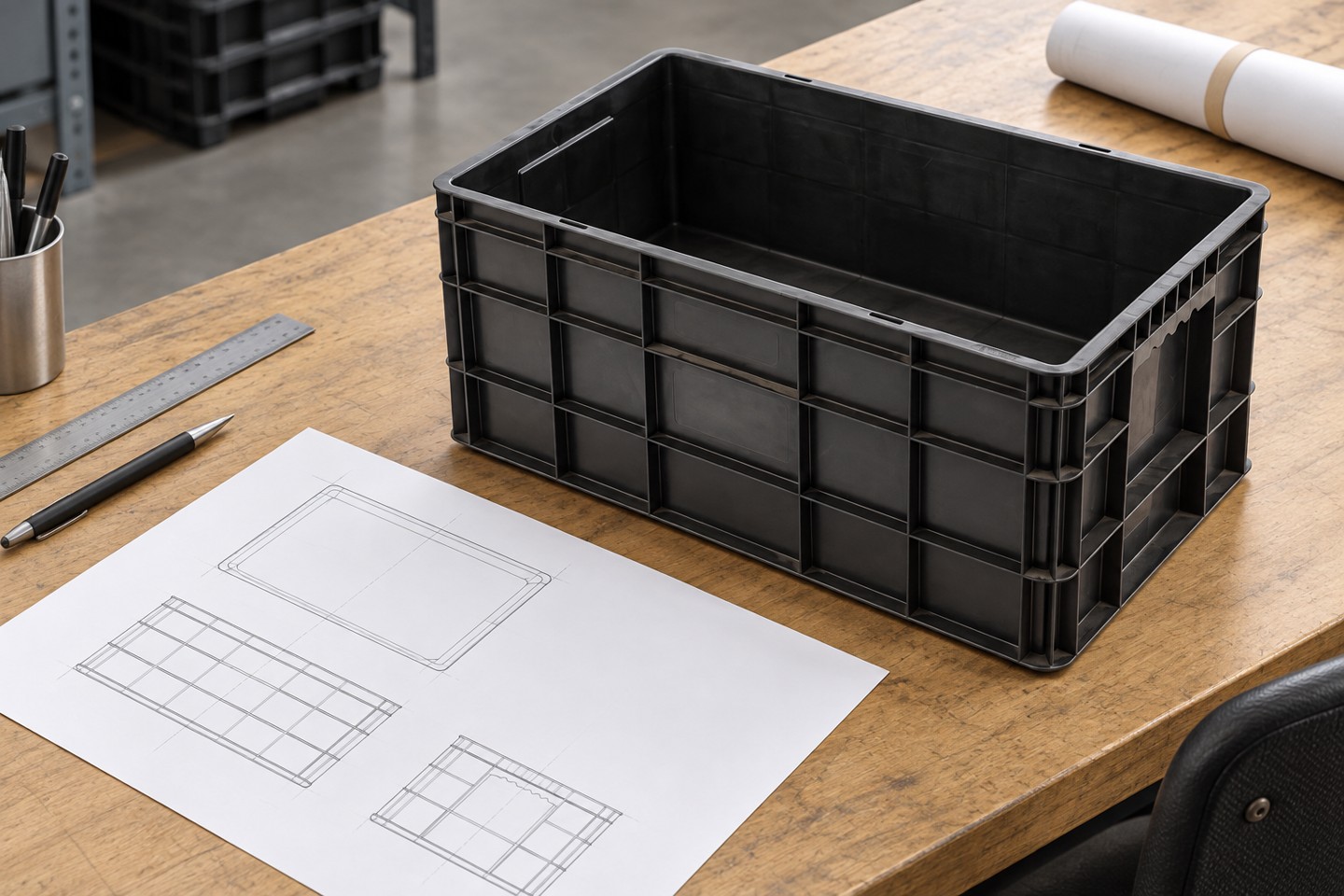
Layout questions for a supplier drawing review
Use the following questions when reviewing a proposal. They are requirements to resolve, not claims that one particular partition material satisfies them. Require a sample and supporting evidence for the exact arrangement. A sketch showing neat rectangles is insufficient when the real modules have uneven shapes, flexible pouches or vulnerable projections.
| Drawing review | Requirement to resolve | Acceptance demonstration |
|---|---|---|
| Product envelope | Include connectors, packaging and permitted variations | Load representative approved product packages without forcing them |
| Support surfaces | Identify where the assembly may contact a support | Show that vulnerable leads and components remain unloaded |
| Compartment identity | Define part, lot and position relationships | Demonstrate identification during loading, removal and reuse |
| Access clearance | Include normal gloves and gripping method | Remove one package without contacting adjacent sensitive products |
| Partition retention | Define installation and allowable movement | Inspect the assembled layout under the agreed handling protocol |
| Material evidence | Identify divider, cushioning, adhesive and labels | Review electrical and cleanliness evidence for the accepted arrangement |
Include manufacturing and assembly tolerances in the supplier review. Ask which dimensions are controlled and how the partition is installed or retained. A loose insert can shift during handling, while a permanently attached structure may be difficult to clean or replace. The correct arrangement depends on the approved process. Do not prescribe an arbitrary clearance or interference fit without reviewing the product, package and supplier’s manufacturing capability.
Keep electrical requirements visible in the specification
The partition material is another part of the ESD control arrangement. Request its identity and the applicable electrical evidence, including the measurement method and conditions. A black divider does not become conductive by appearance, and an insulating divider does not inherit the surrounding box’s properties. Review adhesives, labels, sleeves and cushioning as well. Materials introduced for mechanical organization can change charge generation or electrical contact near a sensitive product.
El EOS/ESD Association’s ESD control principles distinguish low charging behavior, conductive or dissipative behavior, and discharge shielding. A divided container can be appropriate for an EPA while still needing a qualified inner package when it leaves that area. Define those route boundaries before requesting a generic ESD safe certificate. Keep the evidence linked to the finished partition arrangement and the product package actually used in production.
Check access with real loading and unloading movements
An operator needs enough space to place and remove the package without gripping a vulnerable connector or levering the assembly against the divider. Demonstrate the task with the approved gloves and normal workstation arrangement. Inspect whether neighboring packages obstruct access or require touching exposed devices. If a lifting feature is proposed, ask whether it belongs to the product package or the carrier and verify its suitability before adopting it.
Include error recovery in the trial. What happens when the wrong module is placed in a compartment, a pouch becomes folded or a label is unreadable? Operators should be able to isolate the condition without forcing parts into position. A layout that prevents the correct package from being inserted is preferable to one that accepts several incompatible orientations indistinguishably. However, do not claim foolproof orientation without testing the relevant variants and documenting the limits of the design.

Separate retention, cushioning and transport qualification
Partitions may restrict lateral movement but still leave clearance that permits impacts. Foam may cushion contact while allowing the product to rotate. A lid can control vertical movement only if its contact and clearance are compatible with the approved package. These are separate design tasks. Determine which combination is needed through a packaging review instead of assuming the grid alone protects an electronic assembly during every route.
Transport evaluation should concern the complete packed arrangement under a defined protocol. Record the outer container, partitions, liners, packages, loading pattern and orientation. Use representative samples accepted by the responsible engineer and agree on criteria before testing. CCOHS storage-layout guidance provides general storage-safety background; it does not certify an automotive electronic shipping package or set its required shock and vibration limits.
Plan cleaning and replacement of the partition set
Corners, joints and removable inserts can collect debris. Determine whether the partition can be removed for cleaning and how it is reinstalled without changing the layout. Ask for compatible cleaning instructions and the relevant cleanliness evidence. A container’s approved cleaning method may not suit an insert or adhesive. Keep the maintenance instructions specific to the accepted combination and inspect for loose fragments, sharp edges or incomplete drying before the set returns to available stock.
Define which damage triggers quarantine: a cracked divider, a distorted compartment, a worn retention feature or a missing support. Do not fill a damaged position with ordinary foam or tape as an undocumented temporary repair. Where replacement inserts are allowed, control their revision and fit. The ESD bin liner selection guide explains the separate cushioning choices, while the existing divider-box RFQ guide covers the broader container purchasing checklist.
Use a controlled sample approval record
Approve the layout with manufacturing, packaging, quality and the people who load the container. The record should identify product variants, approved support areas, compartment arrangement, package type, electrical evidence and handling restrictions. Include photographs of a correctly loaded sample and examples of unacceptable loading where useful. Keep test conclusions within their demonstrated scope; do not describe a supplier sample as universally automotive compliant without the applicable customer’s documented approval.
For the outer-container discussion, review SWESD’s ESD tote box and request a proposal suited to the actual assembly. The article’s photographs illustrate a tote and individually protected packages rather than a confirmed catalog partition accessory. Ask the supplier to identify any proposed insert separately, including tooling, minimum order quantity, replacement availability and the evidence needed for your program.
Further learning: ESD protection around sensitive assemblies
The EOS/ESD Association educational lecture below explains why materials and handling arrangements must be assessed as part of a complete control program. It supports the electrical review of a partitioned carrier and does not replace the product-specific sample approval.
Educational video: Introduction to ESD as part of University Lectures, EOS/ESD Association, Inc..
Preguntas frecuentes
Does an ESD divider protect every automotive module?
No. The product drawing, allowed contact areas and handling route determine the layout and the required qualification.
Can partitions replace individual protective packages?
Only if the approved product packaging specification allows it. A divided box does not automatically provide the required electrical or transport protection.
How much clearance should a compartment have?
Determine it from the actual package, tolerances and loading movement. There is no universal clearance suitable for all assemblies.
Can ordinary foam fill an oversized compartment?
Use only approved materials and an evaluated layout. Uncontrolled additions can change contact, cleanliness and electrical behavior.
Does a sample approval imply automotive certification?
No. Keep the approval within its documented product, route and customer requirements; do not infer a broader certification.



Dejar un comentario