- Turbo
- Blog
ESD shielding bag mixed order dispatch reconciliation means checking that each shipment contains the bag products, sizes, closure types and quantities assigned to that customer’s released order. Keep look-alike bags separated until the product identity and packing records agree, resolve exceptions before sealing the shipping carton, and record the actual handoff. A shielding symbol or metallic appearance cannot identify the correct order. This guide concerns dispatch of bag supplies, primarily empty bags. When a shipment contains sensitive electronic devices inside protective packaging, use the approved device-packing procedure as well; a commercial order check cannot establish electrical protection or authorize opening a device package.
Define the dispatch problem before checking stock
A mixed order can arise when two customers buy similar bags, when several sizes share a packing station or when a returned carton is placed beside a current order. The relevant question is whether the actual bag supplies match the released order and destination. It is different from checking incoming bag quality or deciding where a product label should be placed.
Begin with the current order revision and the authorized release. Identify the customer, delivery location, product lines, requested packing and shipping marks. If the order changed during picking, establish which version is approved before comparing the goods. A packer should not decide between two conflicting instructions based only on which one was printed most recently.
Das SWESD ESD-Schutzbeutel-Produktseite is a product-family reference for an inquiry. Use the approved order, drawing or packing specification to establish the actual supplied construction and size. A website photograph is useful for orientation but cannot identify every variant or prove that two visually similar packs are interchangeable.

Give each active order a physical boundary
At the packing station, keep one order’s picked goods, documents and empty shipping cartons together in a clearly defined space. The boundary can use an existing staging position or container under the site’s process. Its purpose is to prevent bags for a second customer from joining the first order while operators prepare outer cartons or answer a query.
When the same bench serves several orders, finish or positively secure one group before switching. Return unneeded bag supplies to an identified stock location through the normal movement process. An unidentified pile at the end of the bench is a poor starting point for the next shipment because its apparent size or metallic color does not restore its item identity.
Keep a separate position for unresolved goods. Do not place a questionable pack beside the accepted order with a verbal reminder to check it later. The dispatch checker needs to distinguish released goods from stock waiting for an identity, count or condition decision. Record who owns the exception and what evidence is needed before it can rejoin an order.
Match the bag product before counting the order complete
Compare the stock identifier with the released item and approved documents. Check the size definition, closure form and any specified printing or packaging. Where dimension verification is required, use the drawing’s definitions and the approved measurement method. Do not assume that an outside dimension is the usable internal dimension or invent a tolerance that the order does not provide.
Bag appearance cannot replace documented performance identity. The Übersicht der Kontrollverfahren und Materialien der EOS/ESD Association explains that ESD control involves different material and protective functions. A metallic-looking bag is not, on visual appearance alone, proof of the specific protection required by a customer’s application.
If two product codes appear equivalent but the released order specifies only one, ask the authorized owner to resolve the substitution. Do not change the packing list to make the picked stock appear correct. When a substitution is approved, retain the approval and update the relevant order record through the established route so receiving can understand what was actually supplied.
Use an order-to-carton reconciliation table
The table below is a suggested dispatch worksheet for bag supplies. It does not establish an ESD qualification method, a mandatory label format or a universal packing quantity. Adapt the fields to the actual customer instructions and the identifiers your business uses.
| Überprüfung | cURL Too many subrequests by single Worker invocation. To configure this limit, refer to https://developers.cloudflare.com/workers/wrangler/configuration/#limits | Resolve before handoff |
|---|---|---|
| Order version | Released instruction and current changes | Conflicting releases |
| Produktidentität | Approved code and actual pack identity | Look-alike or unknown stock |
| Size and closure | Drawing definitions and supplied variant | Unapproved substitution |
| Menge | Agreed unit and verified allocation | Pack-versus-piece mismatch |
| Carton contents | Line allocation and carton reference | Mixed or duplicate allocation |
| Bestimmungsort | Released delivery details and shipping label | Wrong customer or address |
| Übergabe | Actual carton count and dispatch record | Partial collection or missing carton |
The count basis should stay consistent from picking to the final packing record. If an order is in packs but the bench count is in individual bags, confirm the exact conversion for that item. Keep the physical pack count and calculated piece quantity visible as different fields. An unexplained total can conceal a pack-size mistake even when the arithmetic is correct.
Check each carton without losing the order connection
Assign each prepared carton a reference that connects it to the order under the site’s procedure. Record which lines and quantities it contains, particularly when an order is split across cartons. The checker should be able to explain the contents of carton one without opening carton two to guess how the total was divided.
For a hypothetical example, one order requests 12 packs of one approved bag item and four packs of another. If the first carton contains eight packs of the first item, the remaining allocation is four packs of the first and four of the second. The order total alone cannot detect a second carton containing eight packs of the wrong item. Check by line and unit as well as by overall quantity. These figures illustrate allocation and are not SWESD packing specifications.
Das GS1 receiving advice introduction provides useful context from the receiving side: the recipient may need to distinguish what was dispatched from what was received and accepted. A clear dispatch record makes later reconciliation possible. This does not require every small shipment to implement GS1 identifiers or electronic messages; agree an appropriate identification method with the customer.
Keep label placement separate from label meaning
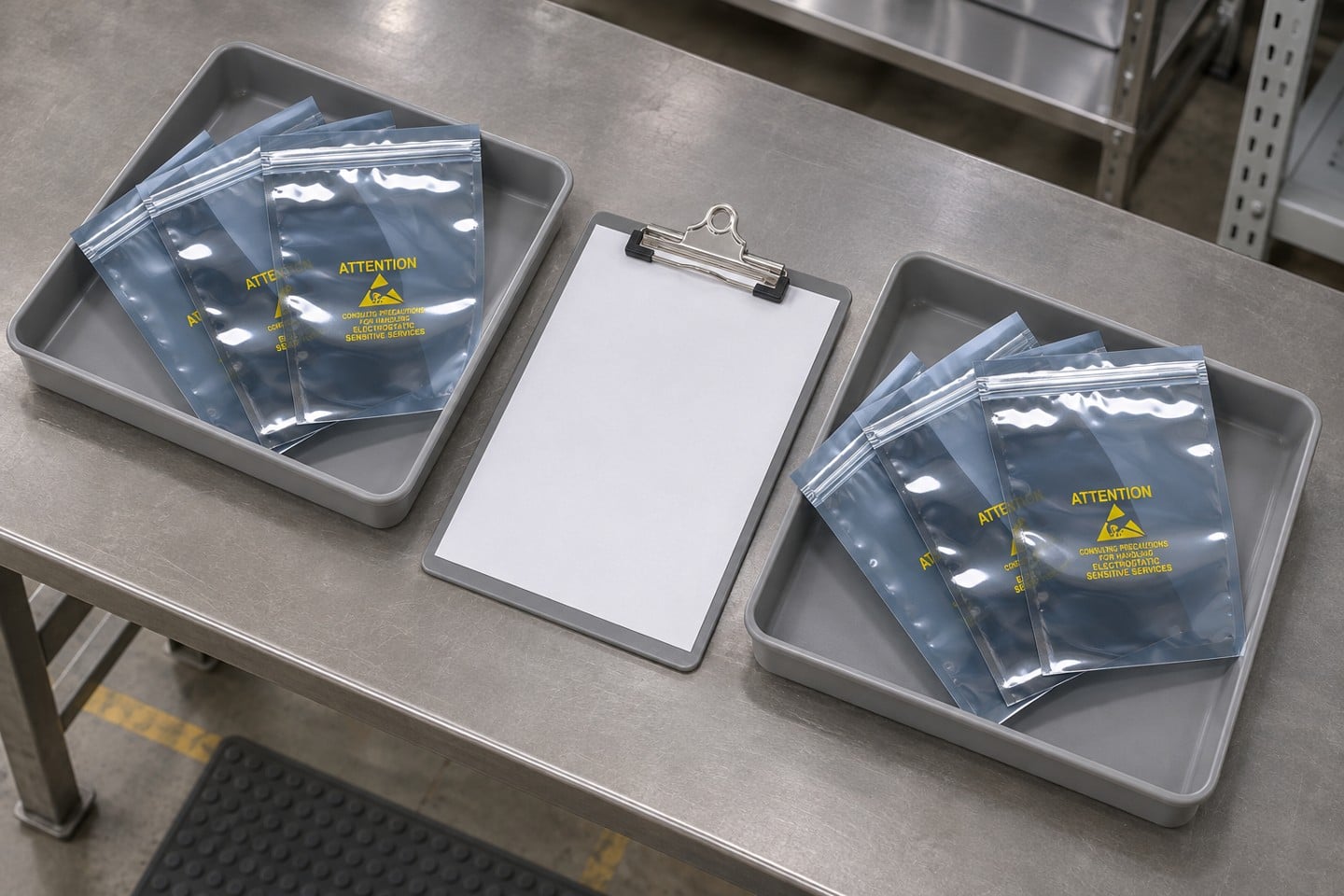
A correctly placed shipping label can still name the wrong destination. At the final check, compare the destination on the prepared carton with the released order, rather than only confirming that a label exists. If the shipment has multiple destinations or delivery instructions, preserve the line-to-destination allocation and resolve ambiguity before the carrier handoff.
Likewise, a product label should describe the actual contents and approved item. Do not cover original supplier identity or unresolved markings merely to make the carton look uniform. The article on ESD shielding bag identification label placement addresses physical placement and protection concerns. This dispatch check addresses whether the information belongs to the correct product and order.
If a mixed label is discovered after packing, isolate the affected cartons and establish the scope before replacing it. Check whether the error belongs only to the outer shipping label or whether product packs have also crossed between orders. Reprinting one label is sufficient only when the evidence establishes that the contents and remaining associations are correct.
Handle exceptions before the shipping handoff
Typical exceptions include an unknown inner pack, a product code mismatch, an unexplained pack count, damaged bags or conflicting destination instructions. Record the affected carton and quantity, preserve the original evidence, and assign a disposition owner. Avoid recording the entire order as checked when one carton remains unresolved.
If replacement stock is picked, verify it against the same released line and record the movement. Remove the rejected or uncertain stock from the dispatch group so it cannot be counted again. An operator’s intention to replace it is not evidence that the replacement happened. A second check should confirm the final contents after the correction, using the approved inspection coverage.
For condition questions, consult the separate Schirmbeutel-Eingangsprüfungsleitfaden. It addresses product acceptance rather than order allocation. Do not turn a dispatch worksheet into an improvised electrical test, and do not call a visual check a complete shielding-performance verification.
Preserve the actual dispatch event
When the order is released for shipping, record the actual cartons handed over, their references and the shipment document under the normal process. Keep partial dispatches explicit. If two of three prepared cartons leave and the third remains on site, the dispatch record should reflect two, with the remaining balance still controlled.
Preserve corrections rather than rewriting history. A packing-list revision after carrier collection needs a clear reason and a record of what was actually handed over. If there is uncertainty, promptly involve the responsible shipping and customer-contact owners through the approved channel. A document correction alone cannot move goods or prove the contents of a carton already outside your control.
When a customer reports a mixed order, compare the original line allocation, carton references and handoff record with the customer’s actual receipt. Ask for relevant identifiers and observed differences. Distinguish a wrong bag item, short quantity and wrong destination, because each may require a different recovery action. Do not assume the complaint proves a bag-performance failure.
Review repeat errors and the protection boundary
Use confirmed incidents to improve the point that failed. Similar bag sizes may need clearer location identification. Order changes may need a better release signal. Pack-to-piece errors may need an explicit unit field. A carrier handoff difference may need a final carton count. The corrective action should address the observed cause instead of adding a signature that cannot detect it.
If the work also involves packaging electronic components, keep commercial identity and ESD protection as separate checks. The broader ESD shielding bag selection guide helps frame packaging requirements. A correct customer, quantity and destination do not establish that the selected construction and closure protect a particular device through its handling route.
Further learning about ESD protection
The EOS/ESD Association university lecture introduction below supplies background on ESD. It supports the distinction between dispatch accuracy and a protection program. It is not a pick-and-pack tutorial, proof of a particular bag’s performance or permission to open protected devices at an ordinary shipping bench. Use the customer’s approved packing requirements for the actual shipment.
Häufig gestellte Fragen
Identifiziert das ESD-Symbol die richtige Kundenbestellung?
No. Match the actual product identity, released order and destination records.
Können ähnliche Metalltaschen als Ersatz verwendet werden?
Use only the approved product or obtain an authorized substitution supported by the applicable requirements.
Does this worksheet qualify shielding performance?
No. It reconciles dispatch identity and quantity; electrical protection needs separate evidence.
Can a corrected packing list prove the shipped contents?
No. Preserve actual carton allocation and handoff evidence; a document change alone does not establish physical contents.
Does this guide authorize opening packages containing sensitive devices?
No. It primarily covers dispatch of empty bag supplies. Follow the approved device-handling and packing procedure for protected electronics.
Neuester Beitrag
-
-
 Nitrilhandschuh-Lieferung Kurzmenge: Empfang abgleichen27. Nov., 2026
-
Schreiben Sie eine Antwort